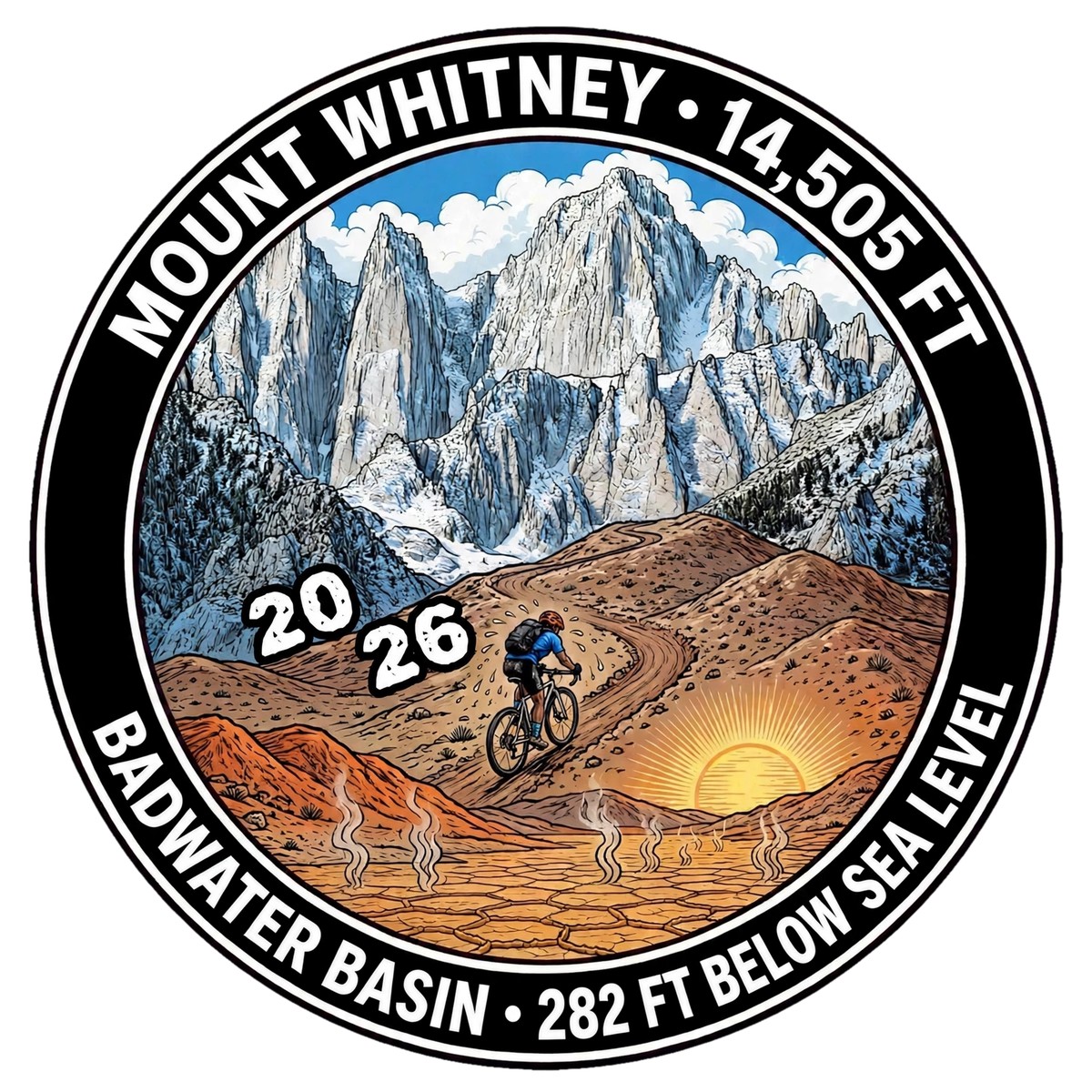
“The best alpinists are the ones with the worst long-term memory.”
— THE DALAI LAMA (PROBABLY)
A note on the narrator, and on units
This account is written in the third person, as is the custom of the great expedition narratives. The author is Arndt, who for much of the period described was sleep-deprived, hypoxic, hypoglycaemic and, for the first 70 kilometres, riding with his rear brake on; his testimony should be weighed accordingly. Where his memory fails, the account relies on the expedition's chronographs. Strava strips the timestamps from everybody's recordings but one's own, so the movements of the others have been reconstructed from point counts, photo metadata and the group chat, with the kind of confidence normally reserved for carbon dating.
Units are metric, as is proper, followed in brackets by what this account calls freedom units: Mount Whitney is 4,421 m (14,505 freedom feet) high. The author regrets the brackets.
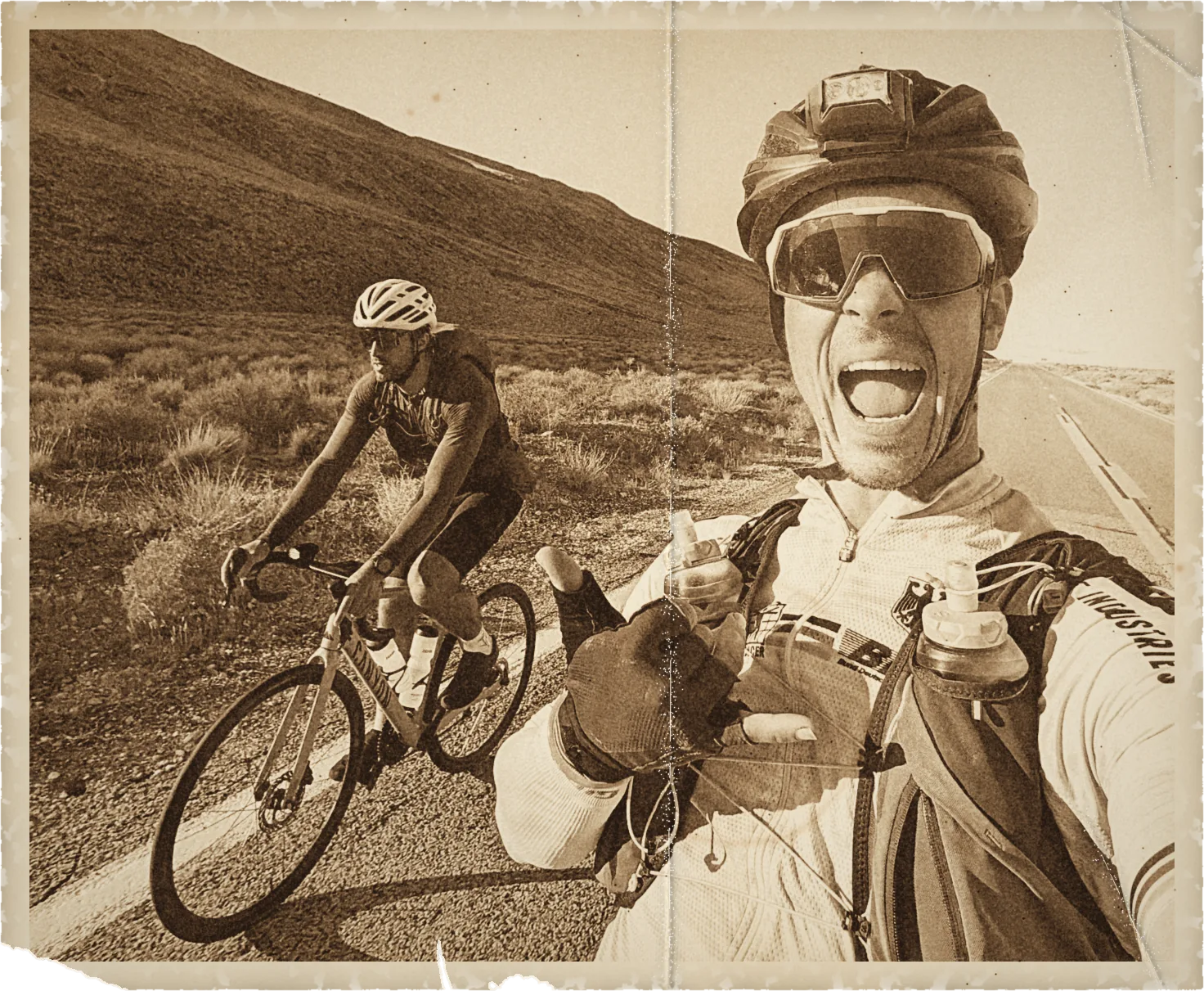
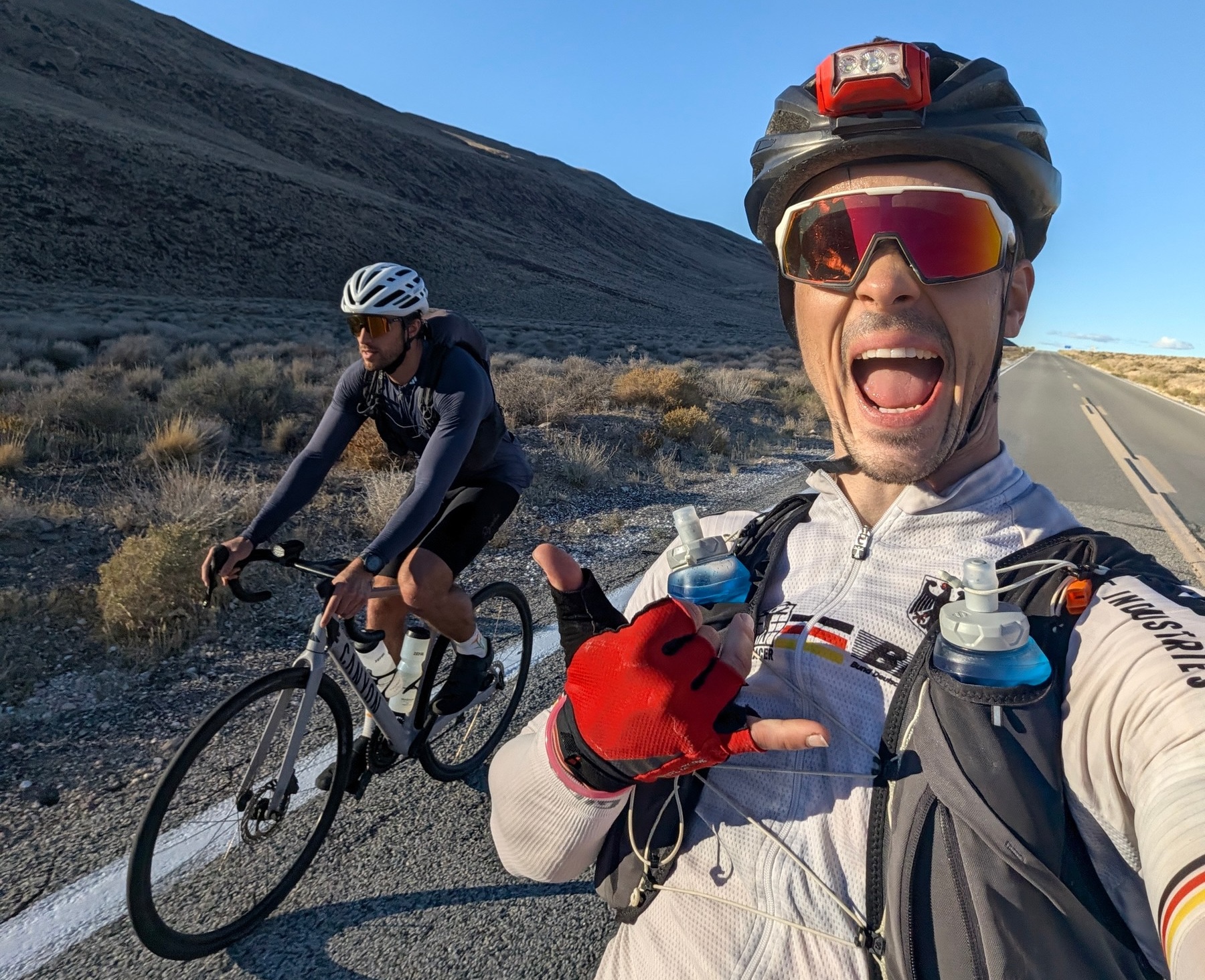
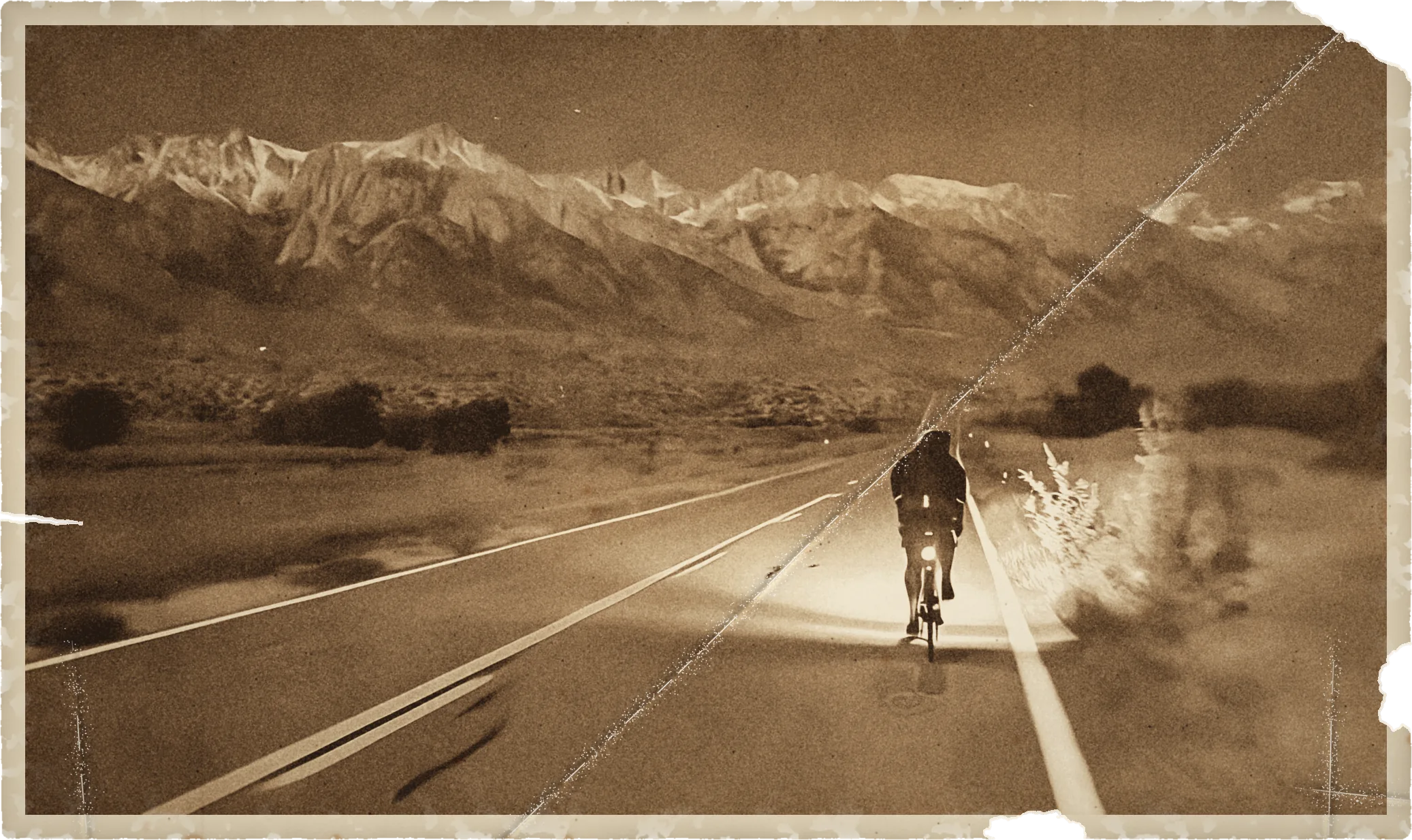
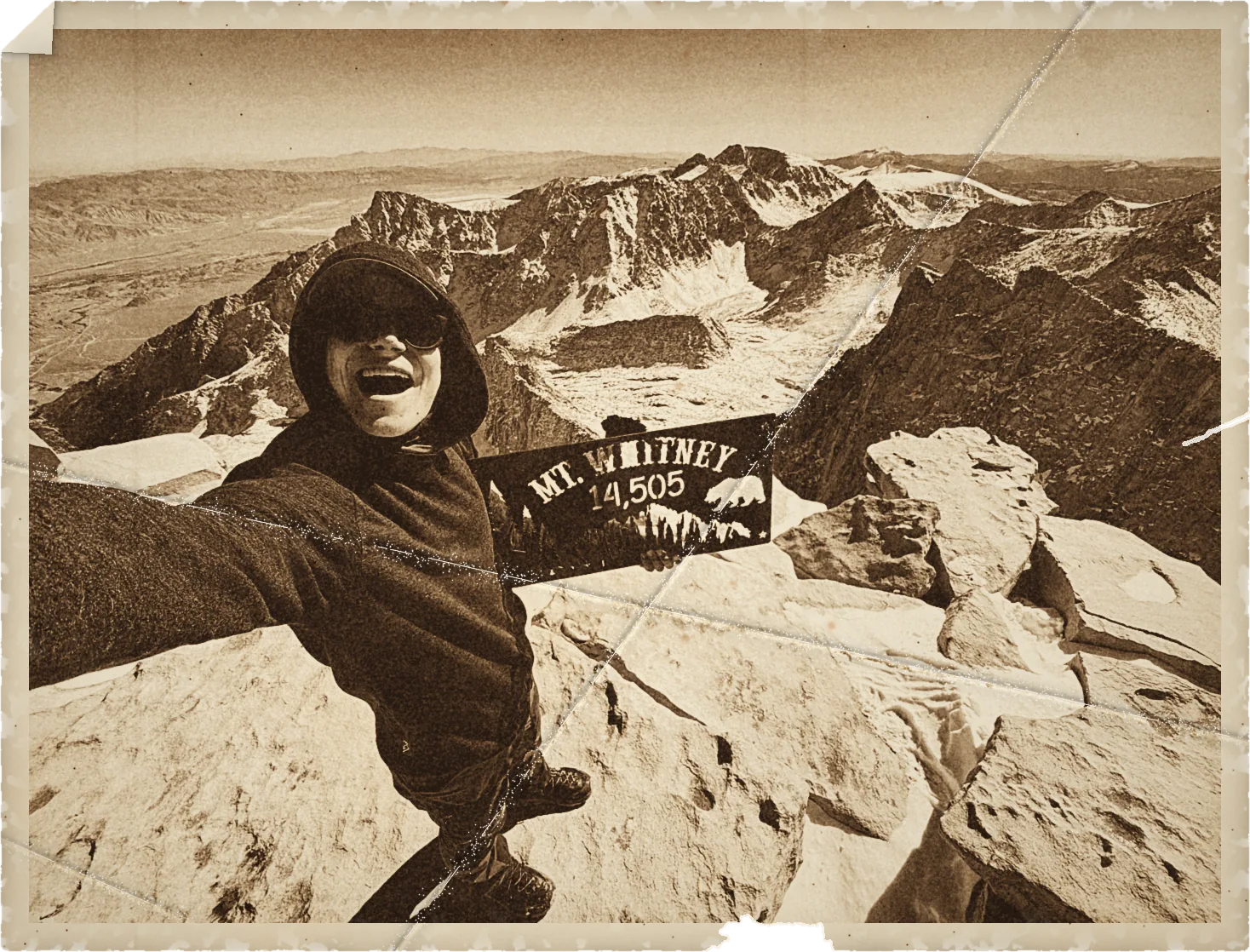
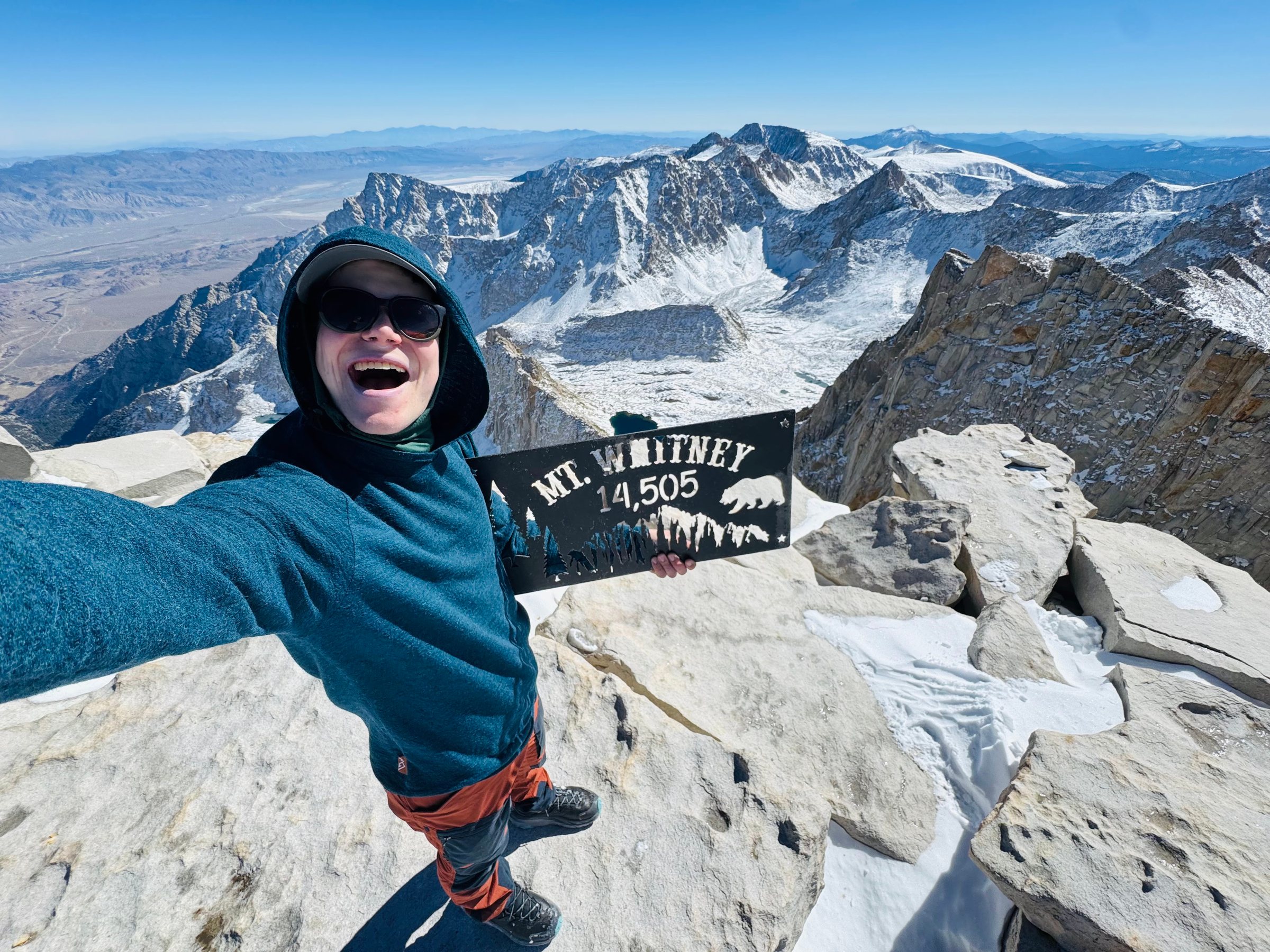
The photographs have survived only as faded, dog-eared prints, in roughly the condition of the men in them. Hover over a plate, or tap it, to see it as it was.
Contents
- iIn Which Nobody Will Ever Do This
- iiMen Wanted
- iiiLogistics, and Other Mistakes
- ivInto the Wind
- vStovepipe Wells
- viTowne Pass
- viiPanamint Springs
- viiiBy the Light of the Moon
- ixA Carl's ——ing Junior
- xThe Mountain
- xiThe Crest
- xiiThe Summit
- xiiiThe Retreat
- —Findings of the Board of Inquiry
- —Appendix: The Route, with Casualties
Chapter IIn Which Nobody Will Ever Do This
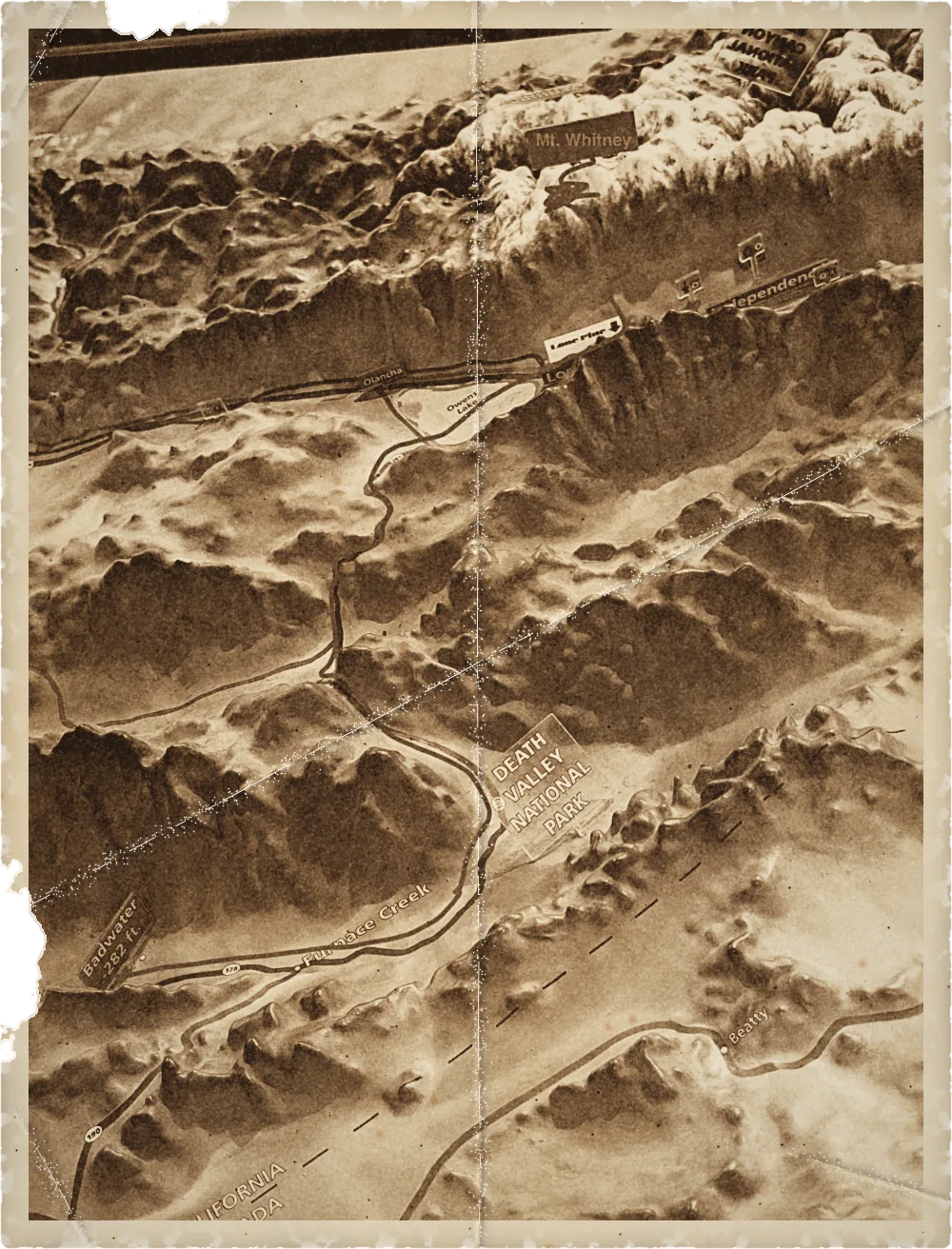
The Badwater to Whitney is an idea of great simplicity and no merit. One starts at Badwater Basin in Death Valley, 86 m (282 freedom feet) below sea level and the lowest point in North America; rides 220 km (137 freedom miles) over two mountain passes to Whitney Portal; and then walks up Mount Whitney, the highest point in the contiguous United States, all under one's own power, in a single push, and ideally in under 24 hours. The record, set by a certain Haidet eighteen days before the events described here, is 11 hours and 23 minutes. The expedition decided not to discuss this.
The difficulty, besides the distance and the mountain, is that there is no season in which both ends are pleasant at once, and no telephone signal in between with which to organise the cars. The expedition would get both wrong.
Arndt first heard of the venture in 2024 from Brown and Colosi, who had both attempted it and both failed, and whose accounts afterwards dwelt chiefly on pain. (Brown also describes his 4:19 marathon as “quite painful”.) Arndt and Sandler, his regular climbing partner, agreed at once that it was a bad and painful idea in every way, shape and form, and that they would never do it. Readers acquainted with these two, whose last joint appearance in these pages ended in an unplanned bivouac, will know how this went. By March 2026 the idea had simmered long enough to seem delightful:
Telegram · 17 March 2026
Arndt, 23:57 — Yo boys stop if we actually want to do the Badwater to Whitney thing we probably want to figure out when to aim for stop because permits and all
Brown, 23:59 — I got a permit
Brown had already secured eight day-use permits for Sunday 25 October. Arndt added six more for the Mountaineer's Route, on the principle that if one is going to suffer, one should have a choice of routes on which to do it.
The horse question
There was, however, a complication, and it had four legs. Mankind established some thousands of years ago that the efficient way to use a horse is to sit on it. Sandler had reached the opposite conclusion and entered Man Against Horse, a race near Prescott, Arizona, which began in 1983 as a bar bet on Whiskey Row and in which humans run 80 km (50 freedom miles) on the same course as horses. It was to be his first ultramarathon, and it was held on 17 October, exactly one week before Badwater. Sandler beat two horses, and has talked about very little else since. (A full account will appear in these pages in due course; the author, who does not like horses, will not be writing it.) Its bearing on the present narrative will become apparent on Towne Pass.
Chapter IIMen Wanted
Like all great expeditions, this one assembled itself by correspondence: a WhatsApp group that grew over seven months to more than twenty members, each new arrival adding a friend who “might be interested”. In The Times, the notice would have read:
MEN WANTED
for hazardous journey. No wages, 220 km of desert, fierce headwinds, bitter cold, long hours of complete darkness, 99 switchbacks. Safe return doubtful. Carl's Jr. in event of success.
Nine men answered it.
Marshall
Bozeman, Montana · marathon 2:43
Four previous attempts, four finishes. Rode Brown's bicycle, of which more later.
Barry
Claremont · marathon 2:48
Several attempts. Describes the whole thing, in conversation, as “fun”.
Holderness
San Francisco · marathon 2:49
Several crossings; introduced everybody to “these shenanigans”. Had to work on Monday.
Xia
San Francisco · marathon 3:05
Good at driving cars. Knows when it is appropriate to stop.
Stanford-Moore
San Francisco · marathon 3:43
Quite possibly the only man to have studied at a university named after half of himself. Would keep Arndt company for most of the way and much of the meaning of life.
Sandler
San Diego · marathon 5:26
Co-founder and former president of this club. Had recently beaten two horses.
Kessler
San Francisco · no marathon
Methane researcher; mountain biker at heart, for once on a fast gravel bike. Will go slowly, but will never stop.
Gieschen
Orange County · no marathon
Emergency-medicine resident, sailor, holder of a collegiate cycling speed record of some description. Presumed never to sleep. Did not train.
Arndt
San Diego · no marathon
Co-founding member, now “senior advisor” (duties: bringing the beer). German. Rode a 2017 Santa Cruz Highball mountain bike, with aero bars.
Riggle
Orange County · support
Wisely declined to ride and drove the support van instead. Better prepared than at least half the riders. We love Riggle.
Brown
San Diego · in absentia
Obtained the permits; lent his bicycle and his family's condo. Attended a wedding in Hawaii.
Time, mercifully, is measured the same way on both sides of the Atlantic, so the marathons need no conversion. Gieschen called the mountain bike “a cursed idea”. Arndt had already assured the group that he knew “a guy in our group that I can keep up with on my mountain bike”. He meant Sandler.
Chapter IIILogistics, and Other Mistakes
For once, Arndt and Sandler trained: hill repeats on the Black's Beach road, laps of Fiesta Island fuelled by Wayfarer pastries, Palomar, a “SoCal Badwater to Whitney” from La Jolla to the summit of San Gorgonio, and, in Arndt's case, Mauna Kea, reputedly the hardest road climb on Earth, which presented no major difficulties. Confidence was high. Brown, meanwhile, was finishing his graduate studies and job-hunting in an unkind market, while his bicycle gathered dust and its batteries quietly drained. In May he received an invitation to a family wedding in Hawaii on 24 October, which he said he would “regrettably” have to attend, in the tone of a man who has just been pardoned. Unlike his namesake Captain Scott, he did not go back for a second attempt; but he lent the expedition his bicycle and his family's condo in Mammoth Lakes for acclimatisation. Sandler's week there shrank, as the cells in his laboratory misbehaved, to under 24 hours. Arndt, left alone, noticed that one can ride a mountain bike to the summit of White Mountain Peak, over 4,300 m (14,000 freedom feet), and set off on what he described as an easy acclimatisation ride. He spent the remaining six days on Brown's sofa and never quite recovered.
The expedition's most formidable adversary, however, was the motor car. Nine riders, their bicycles and six cars from four cities had to start at Badwater, finish at Whitney Portal and somehow get home, and Holderness, Barry and Arndt spent heroic hours on the planning spreadsheet producing plan after plan, one of them headed “Plan to Avoid anyone driving more than 8 hours afterwards”. On 22 October, after the most elaborate yet had been laid out in full, Gieschen replied:
Telegram · 22 October 2026
Gieschen, 14:34 — Only concern with that is my car only has 2 seats
The spreadsheet gave it five. Arndt calculated that the group had just spent four hours trying to save two hours of driving, and went back to his actual job; Holderness settled the matter by offering to drive everyone back to Badwater himself, which was generous of a man who had to work on Monday. The start time was put to a poll, afternoon against early morning, which finished three votes to three; after another day of correspondence the expedition agreed to start at nine, as the veterans had suggested in the first place. Then there was the weather. A storm was due mid-week, and the correspondence took on a tone familiar to readers of polar literature:
Telegrams · 20 and 21 October 2026
Sandler, 20 Oct — A foot is like a bit heinous honestly, and the forecast is deteriorating
Arndt — Also the forecast is always wrong
Sandler — If we knew which way it was wrong we would be rich men indeed
Sandler, 21 Oct — On the bright side, currently no winds on the forecast, so that's good
In between, Brill, a friend of Marshall's and evidently the only man in the correspondence able to read a forecast, withdrew: “Forecast does not look worth it to me.” He was right on every count.
On Friday the expedition met at Whitney Portal to stow its mountain gear in the bear lockers (along with eight breakfast burritos which Arndt had bought out of a Mammoth café for “group consumption”), left two caches of water and Gatorade by the road, and drove to Stovepipe Wells, where it met its first engineering crisis. Marshall, who had flown in from Montana, was to ride Brown's bicycle. Its rear tyre was flat. The batteries of its electronic gears were flat. Its pedals did not fit Marshall's shoes. Brown, consulted in Hawaii about chargers, said they “should all be the same”. Stanford-Moore produced a Shimano cable, Arndt a coin cell, and the hotel room became a workshop in which Barry, a very strong man, applied the full force of his body to Arndt's delicate torque wrench. The pedals came off. The torque wrench has not been the same since. Like Shackleton's Endurance, Brown's bicycle would not come home entire, but that is to anticipate.
Chapter IVInto the Wind
The day began, as all good days do, with a buffet, at which men about to burn some 60,000 kJ (15,000 freedom calories) apiece ate accordingly. Then the conditions. The storm had laid 60 to 90 cm (two to three freedom feet) of fresh snow on Whitney, turning the Mountaineer's Route into powder over scree and ice; a local mountaineer advised anyone heading up to make the decisions a mountaineer would make and, if in doubt, to “consider tapping the brakes”. The expedition switched, sensibly, to the much longer main trail, and, less sensibly, carried on. (Arndt, it would turn out, had already taken the advice about the brakes to heart.) The forecast had also acquired a feature absent on Wednesday: a northerly wind of 48 km/h (30 freedom miles per hour), blowing straight down the valley the expedition meant to ride up. On the drive to Badwater the men watched the Mesquite Flat Sand Dunes being formed in real time, a natural spectacle they would have been glad to witness on literally any other day of their lives.
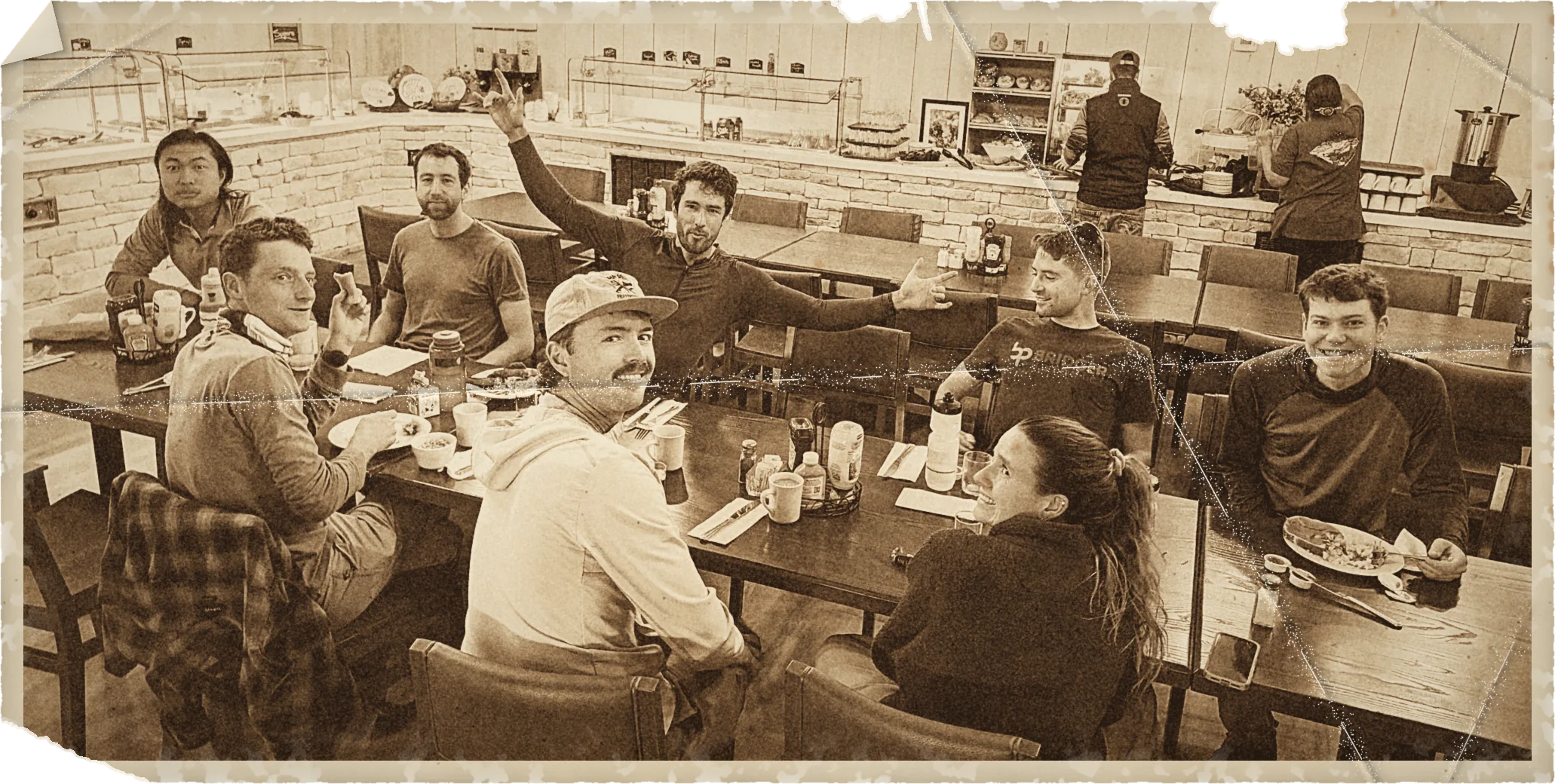
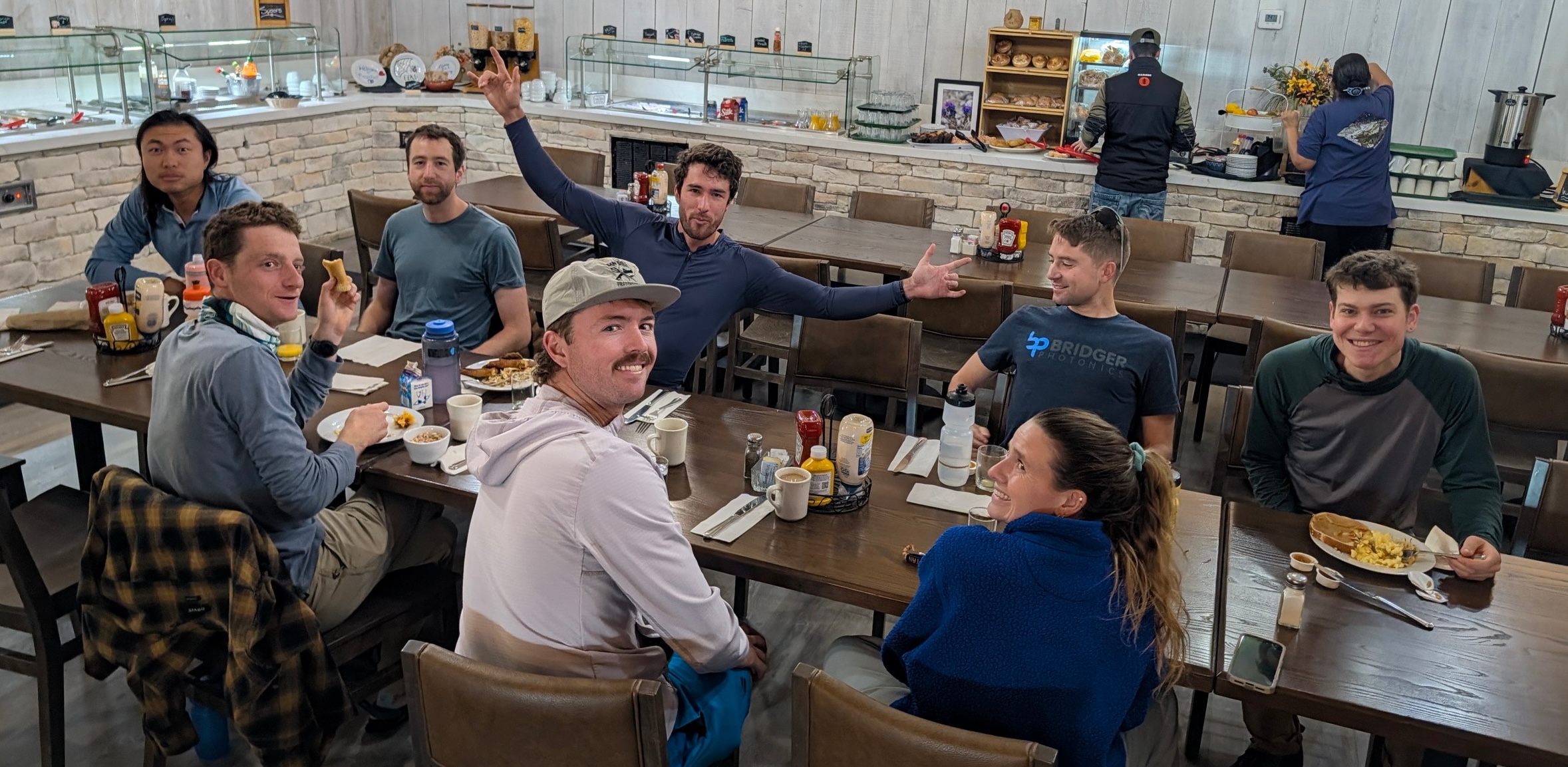
At Badwater a passing tourist surveyed the bicycles and asked the question that had troubled the planning committee for months.
“How are y'all gonna make sure that the one guy on the mountain bike keeps up?” he enquired.
Somebody replied that the guy on the mountain bike was presumably very fit. The truthful answer, that nobody was going to make sure of anything on his behalf, went unspoken. Arndt had his own plan: eight or nine sachets of Tailwind, on the theory that enough Tailwind cancels out a headwind. At 09:48:22 by his Garmin chronograph, the expedition rode north into the wind.
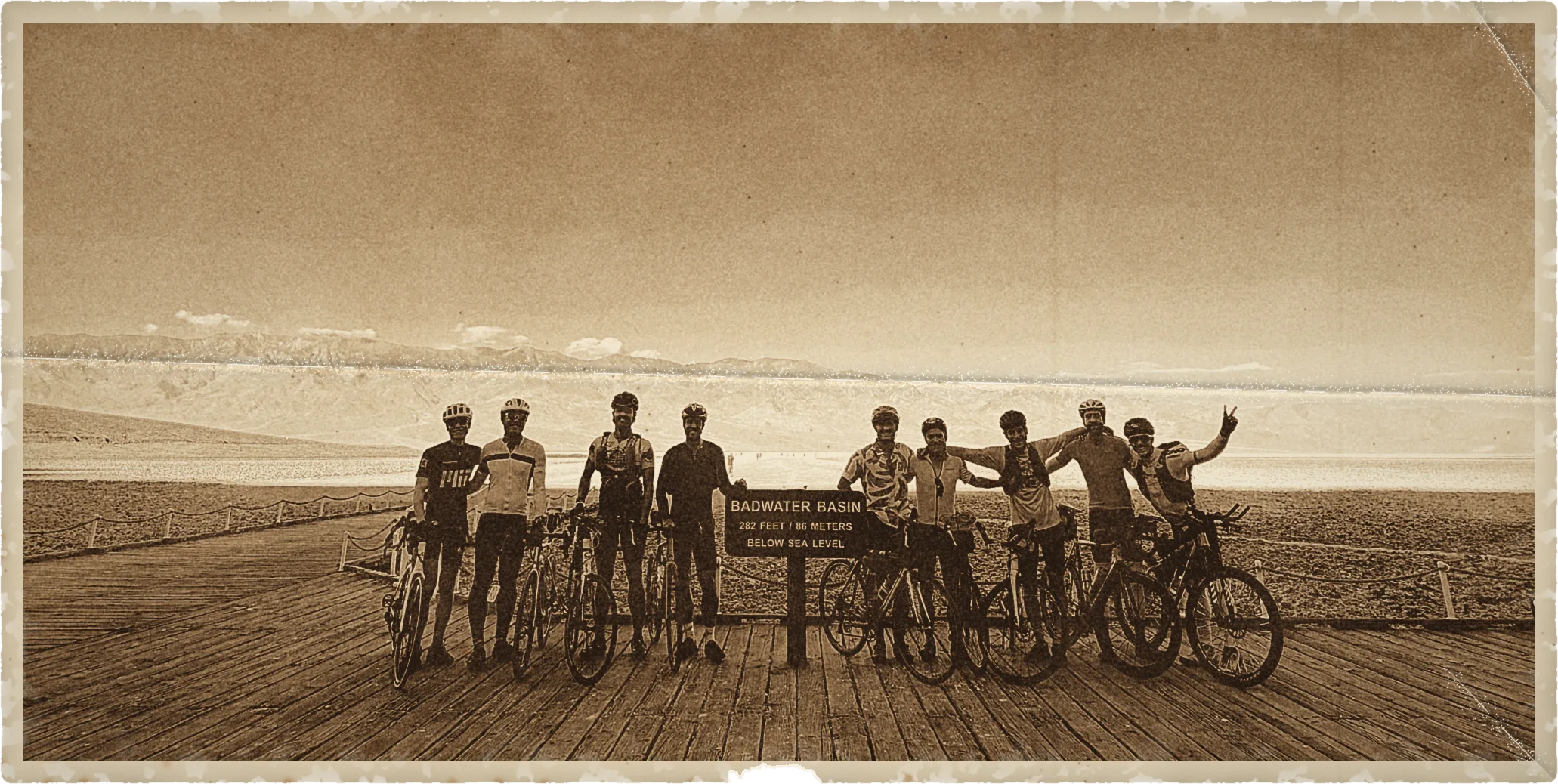
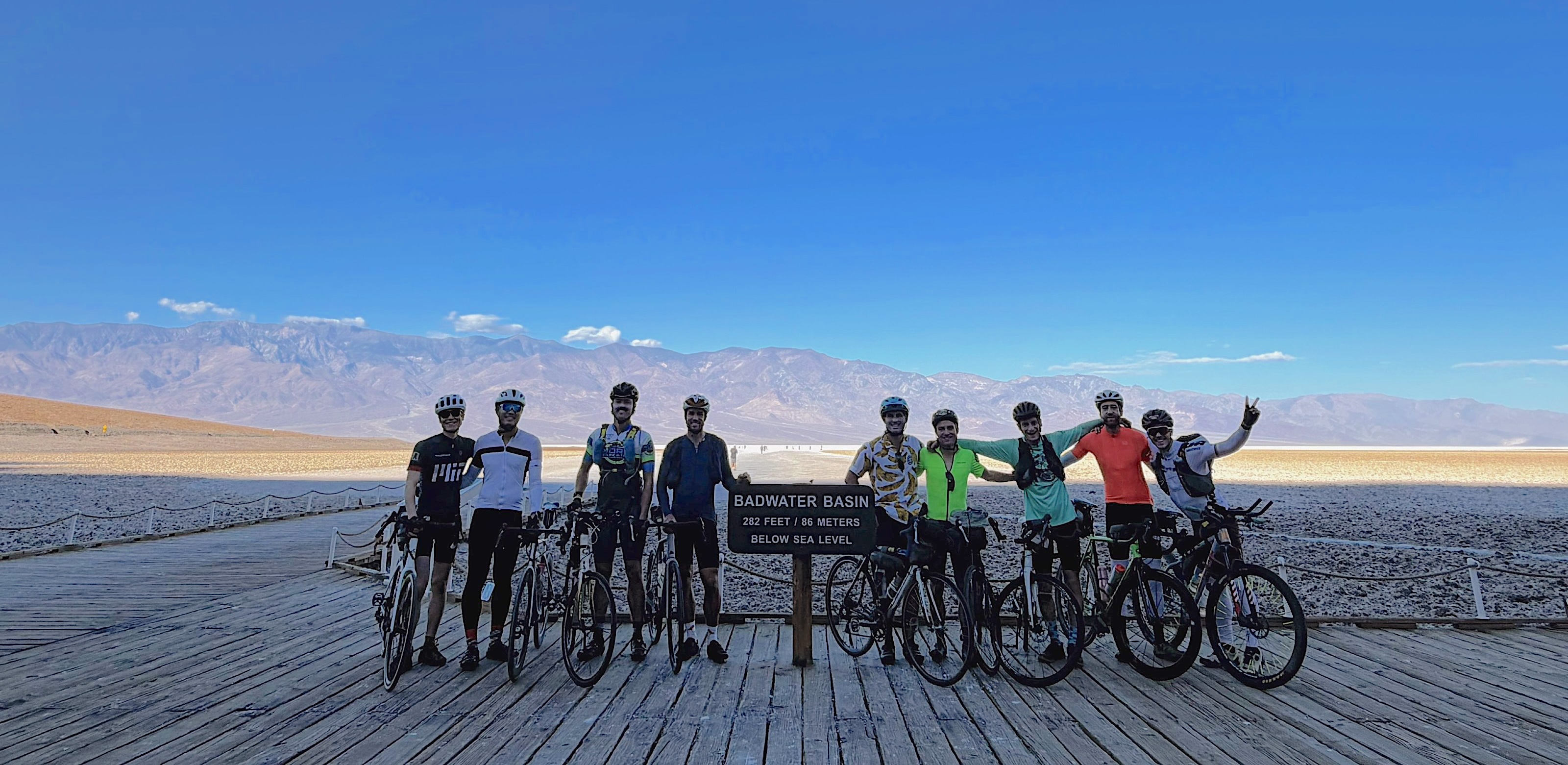
The first thing the men noticed was Barry's cheeks. Certain parts of Barry's cycling apparel had, over years of faithful service, become semi-transparent, and for the opening kilometres his cheeks set the rhythm of the paceline. About two minutes in, Sandler was dropped. The fast group would not wait, so at 10:18:56, 10 km out, Arndt's chronograph records a U-turn. (His recollection is that he went back “a few minutes” after Sandler was dropped; the chronograph says thirty.) For 59 glorious seconds he rode south, with the wind, at 31.6 km/h (19.6 freedom miles per hour), a speed he would not see again for exactly an hour. Then he collected Sandler and rode in front of him, Fiesta style. Stanford-Moore and Gieschen soon came off the back of the fast group too, and the slow group proceeded north to the howl of the wind and the Eurotrash blaring from a speaker strapped to Arndt's frame.
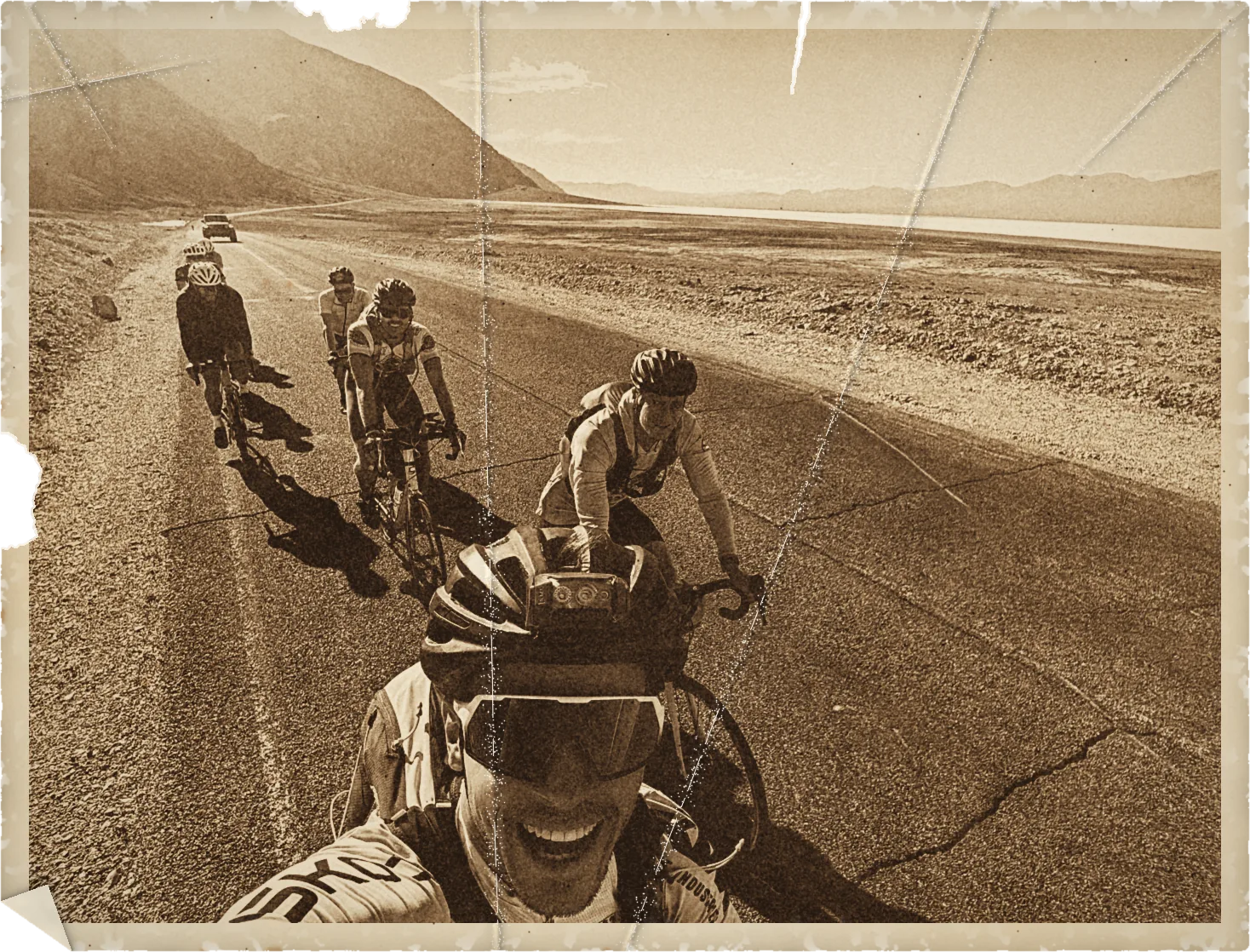
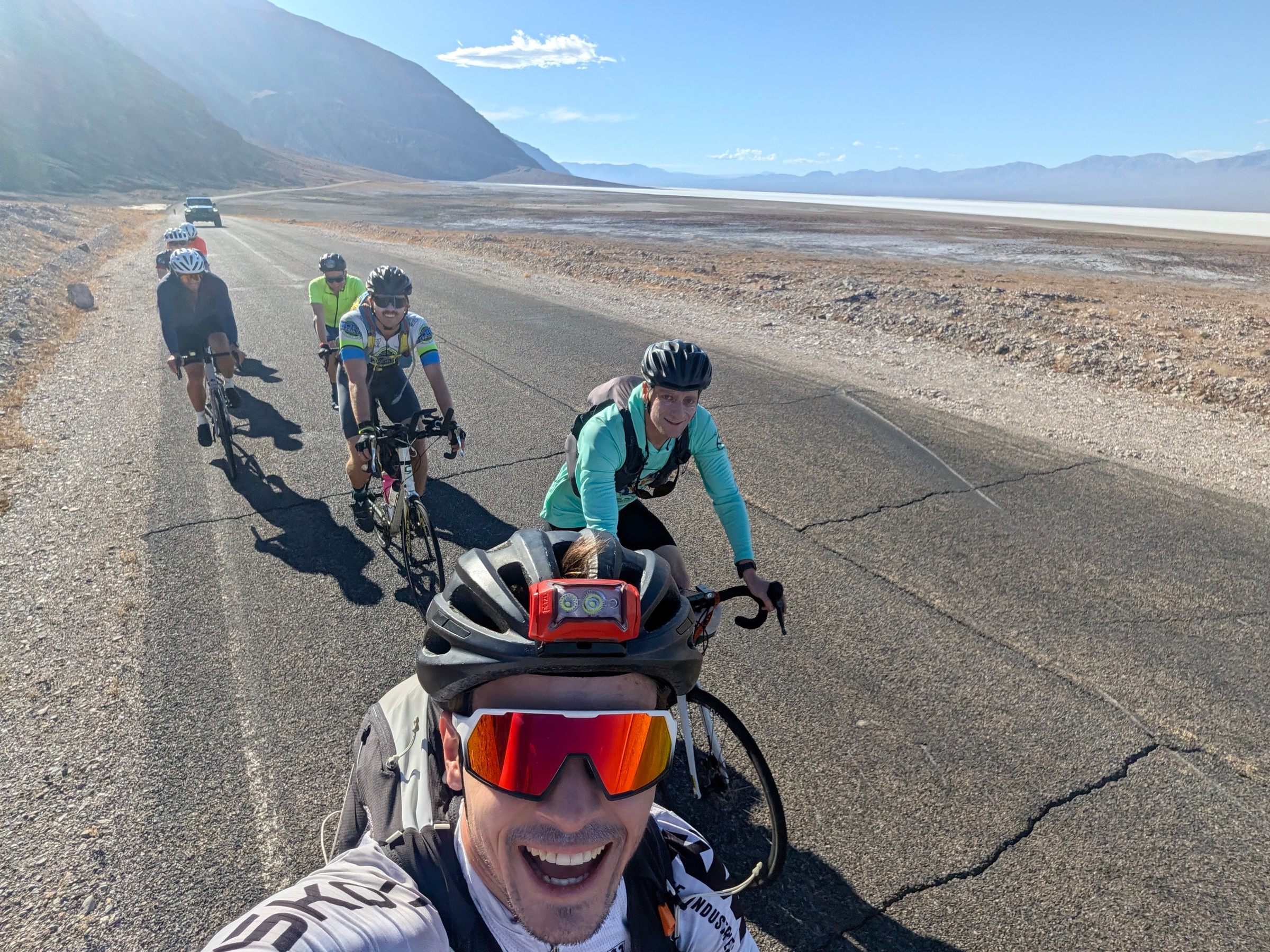
Arndt stayed at the front almost all the way to Stovepipe Wells. It was the hardest he had ever worked on a bicycle, at what felt like 5 km/h (3 freedom miles per hour); his wristwatch says 19.6. He blamed the wind. (His highest heart rate of the entire 32 hours, 163 beats per minute, came at 10:12, 70 m below sea level, on a dead-flat road. It was never approached again, not even at 4,400 m. The reader may wish to bear this in mind.) Gieschen, who had not trained at all, meanwhile reported on life in the fast group's rotating paceline. Whenever his turn at the front came, he would sit bolt upright, all sheets to the wind, and let the headwind slow him until, within three seconds and without fail, some motivated fellow on a carbon racing bicycle came past to take his place.
Chapter VStovepipe Wells
At 13:27 the slow group reached the Stovepipe Wells General Store, faces encrusted with salt like the basin behind them. The fast group had come and gone; the only sign of it was a blurry shape in the distance, resembling Kessler riding up towards Towne Pass, which the men took to be a fata morgana. (It was not. The evidence suggests Kessler left at almost exactly the moment they arrived, and Arndt would not see him again for nearly nine hours.) Having just completed what the planning documents called the short and easy flat part, the men bought ice cream, cold Gatorade and some 2,650 litres (700 freedom gallons) of water. Stanford-Moore then rose with the quiet dignity of Captain Oates (“I am just going outside and may be some time,” he did not say, though it was plainly what he meant) and disappeared behind the building, returning a little later, lighter and paler. A part of Stanford-Moore remains behind the Stovepipe Wells General Store to this day.
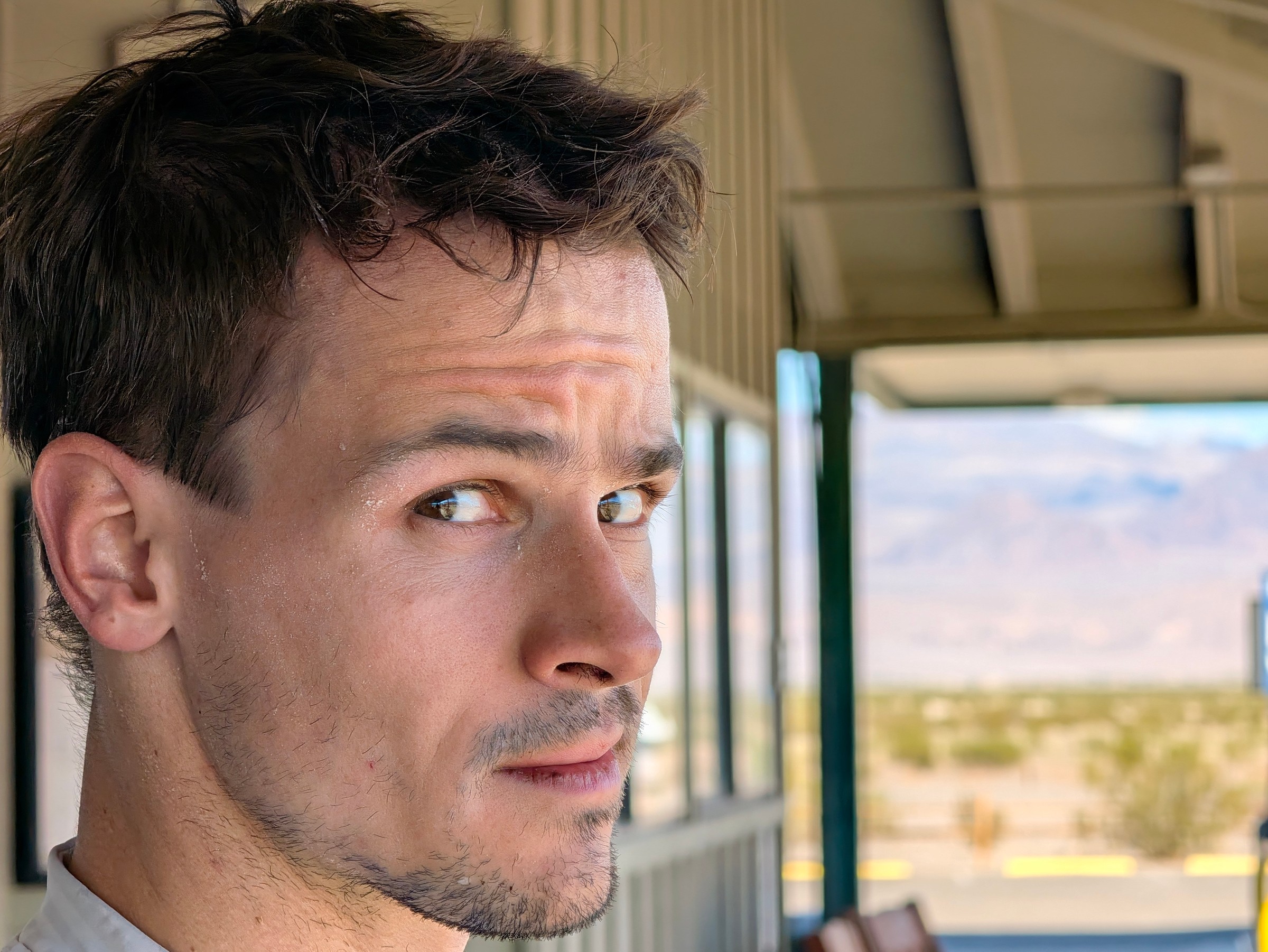
Wheeling his bicycle along the porch, where there was no wind, Arndt found that it resisted being pushed. He lifted the back wheel and tried to spin it. It declined. The wheel would turn only under considerable and sustained persuasion, and stopped dead the moment the persuasion ceased. Something in transit had closed the hydraulic caliper on the disc, and Arndt had ridden the first 70 km (43 freedom miles), into a 48 km/h headwind, at the front of the group, with his rear brake on. He had not noticed, because the wind was so strong.
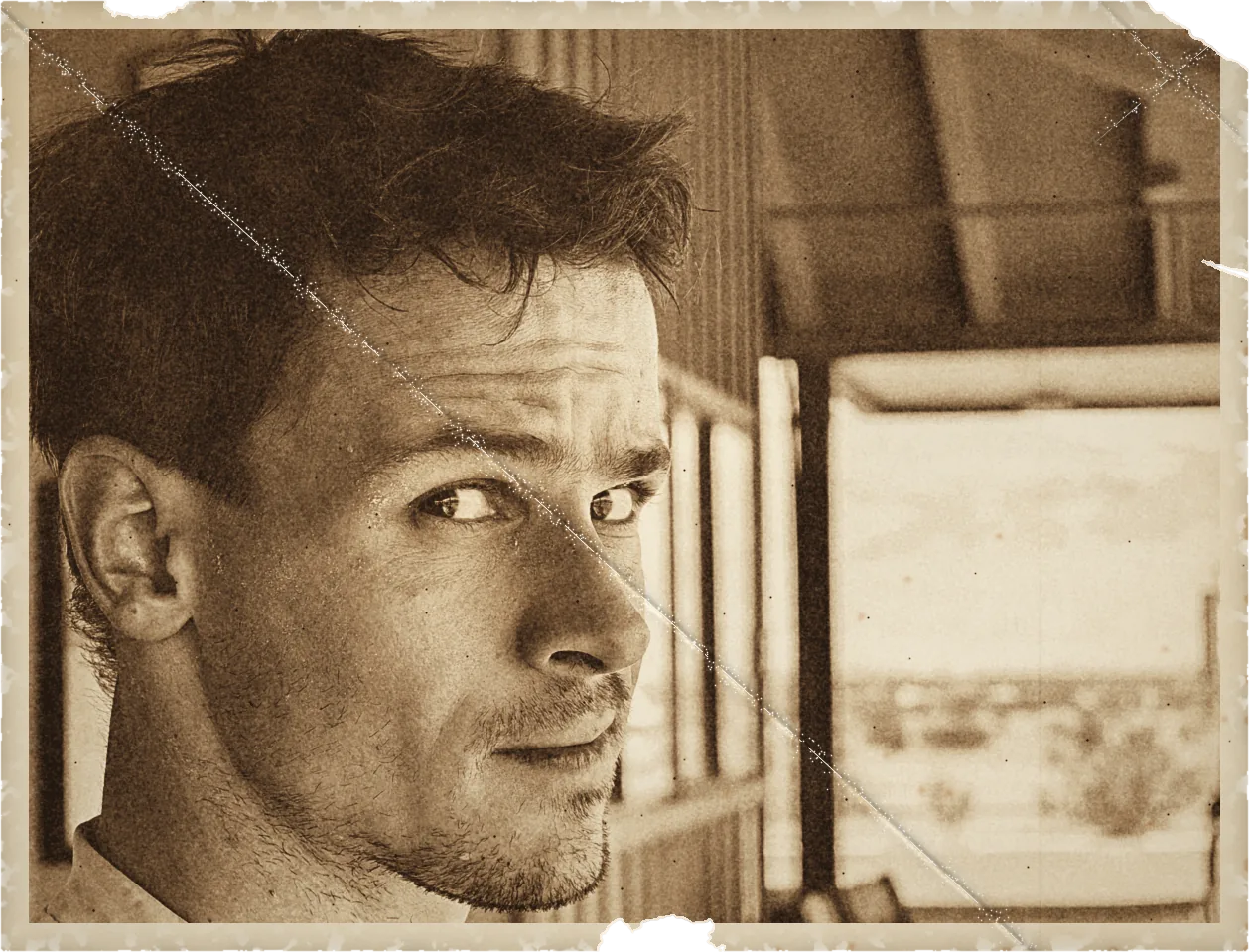
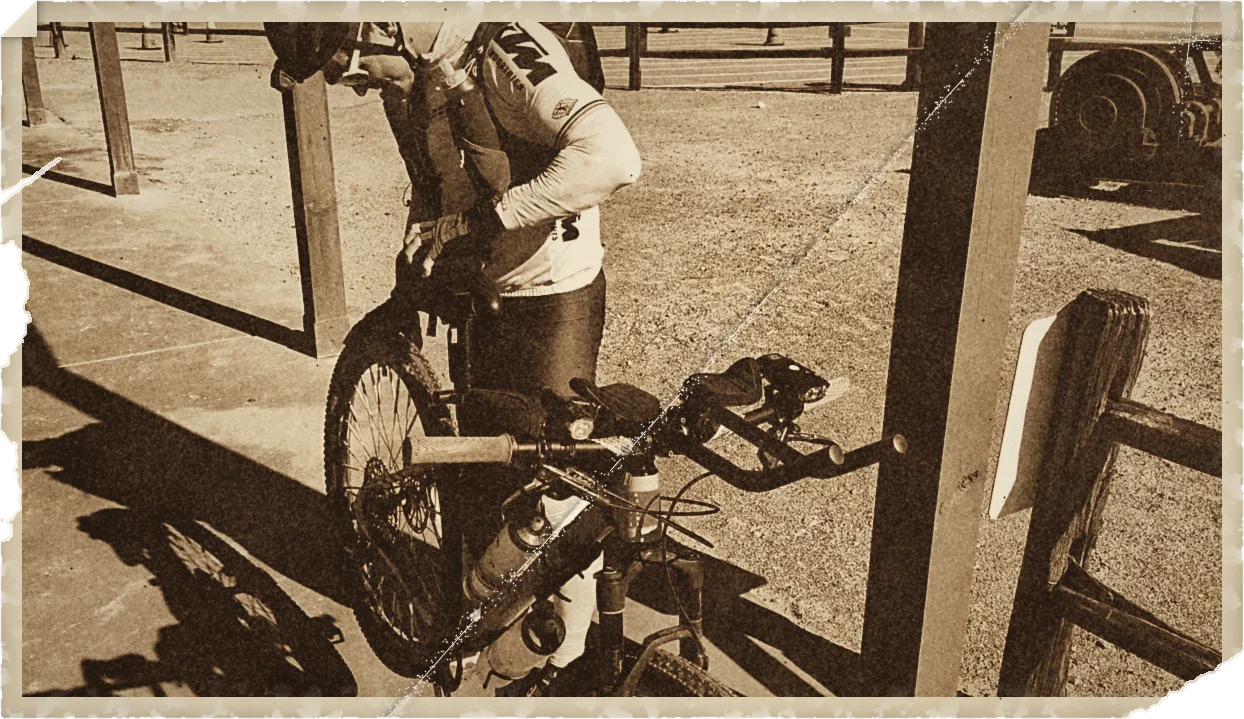
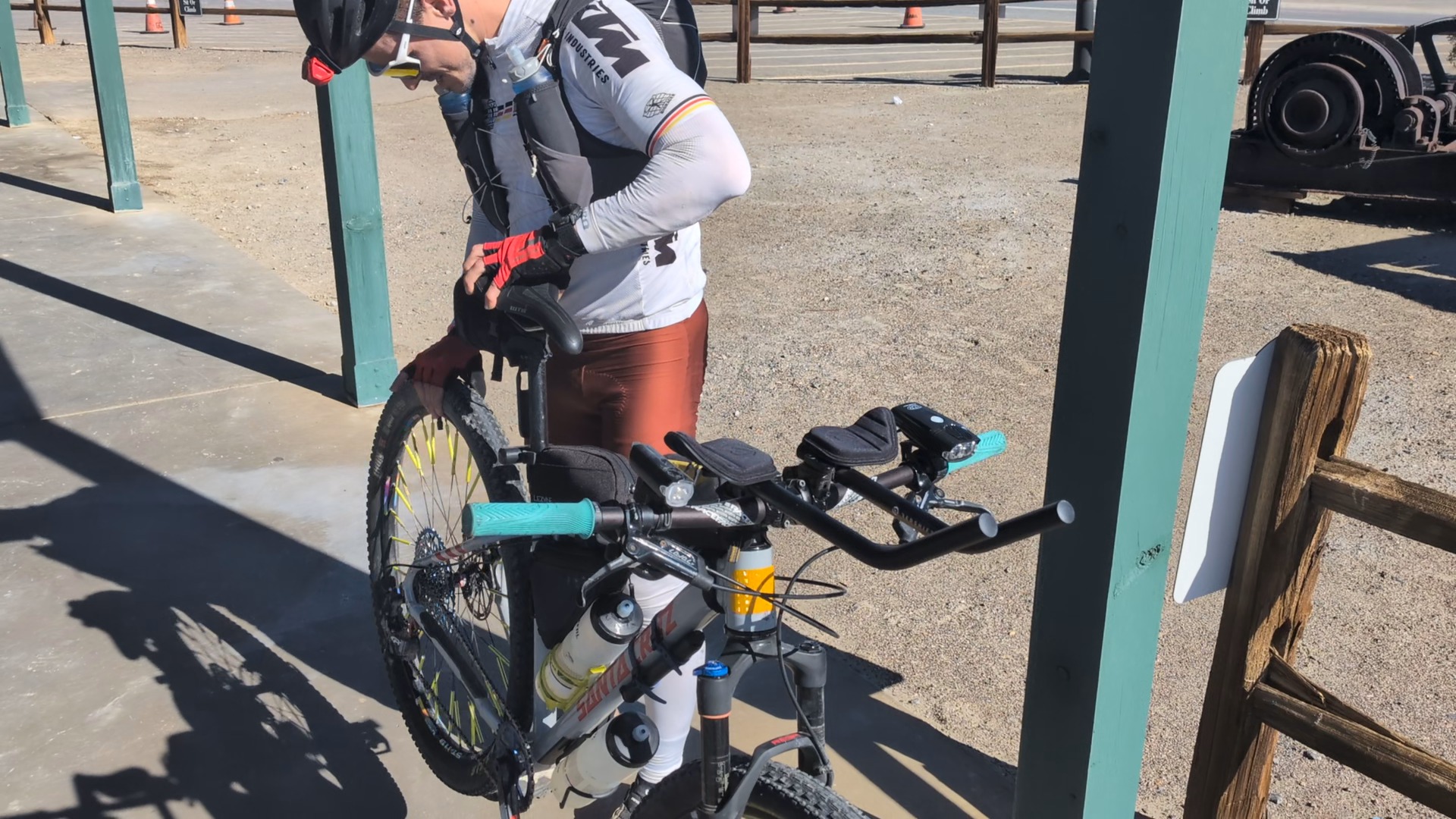
The expedition's packing list had asked every member to “make sure bike is in good shape!”; in the column provided, Arndt had written “fill air into suspension, charge lights”. The advice to consider tapping the brakes had, in its way, been followed. A couple of dozen squeezes of the lever put things right, during which his Garmin chronograph recorded the hottest temperature of the trip: 36 °C (97 freedom degrees), measured on a wrist, which is not where meteorologists keep their thermometers.
Chapter VITowne Pass
With no wind and no brake, the 1,500 m (4,900 freedom feet) climb to Towne Pass felt to Arndt like a holiday. Sandler suffered in the heat, and halfway up he discovered why: he had put a thermal base layer on under his sun hoody for breakfast, and forgotten to take it off. Two-thirds of the way up, at the water cache, Riggle was waiting with the air-conditioned support van. Sandler regarded it for some moments and announced that he had had enough. First man down.
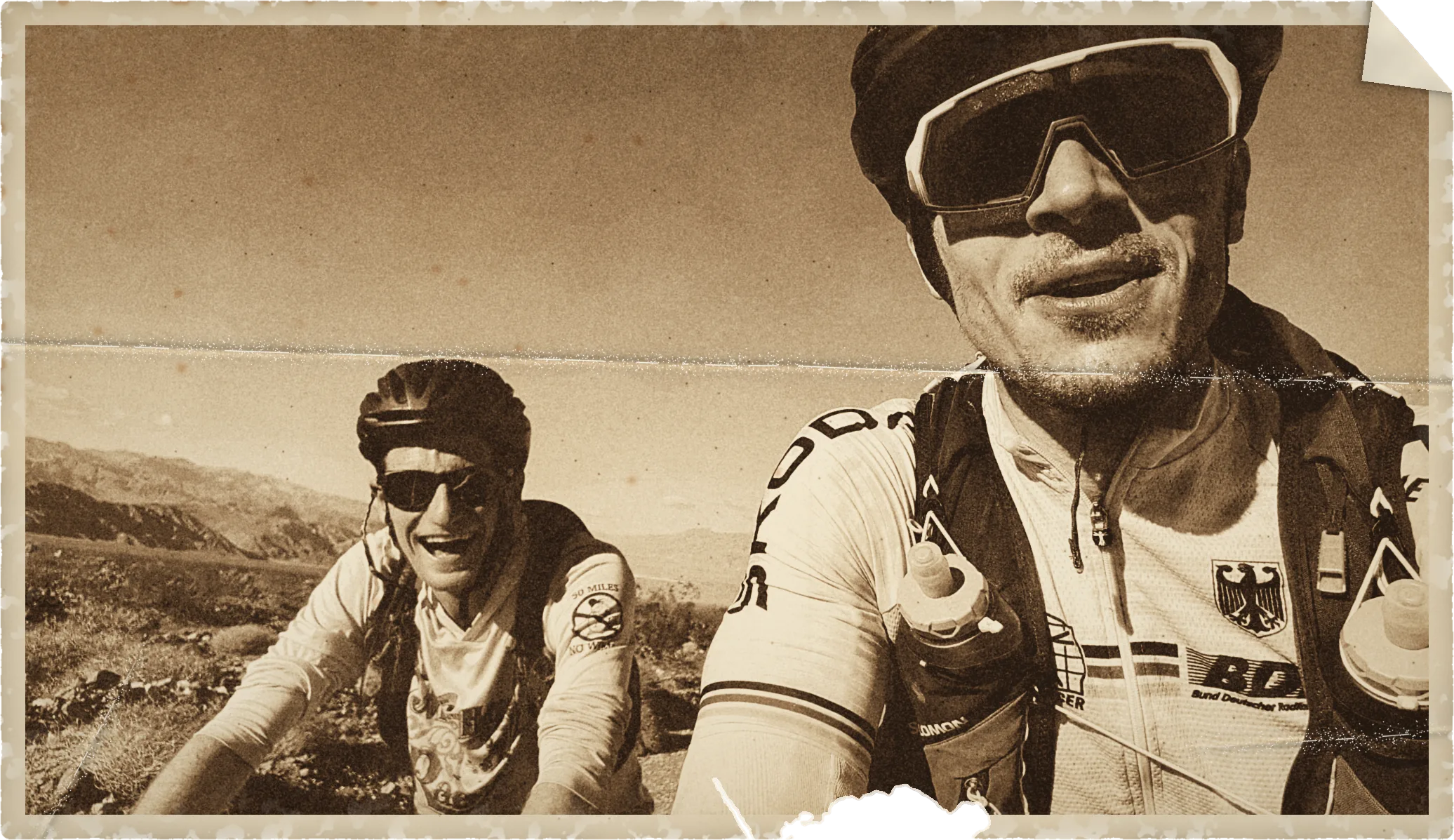
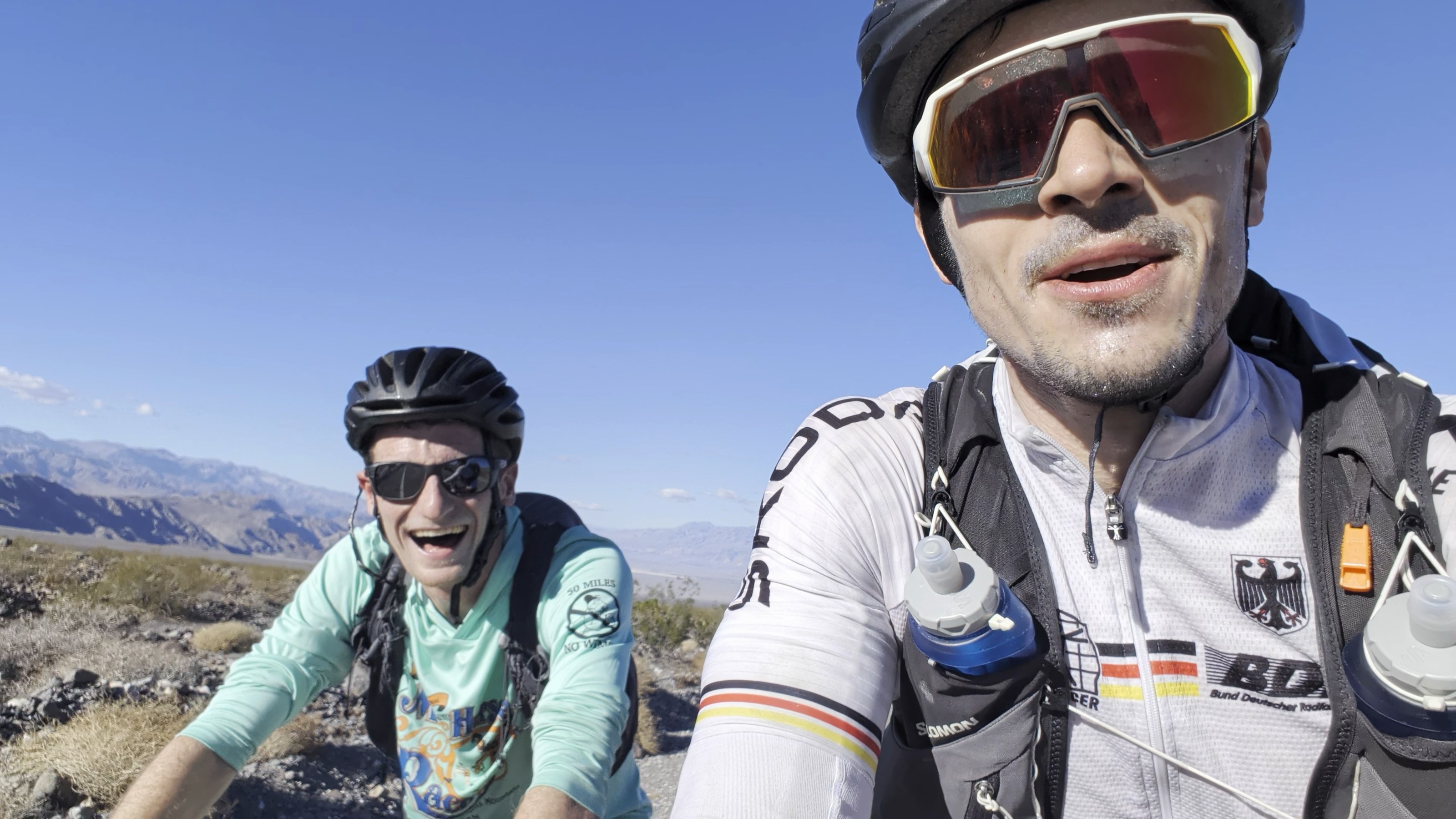
Sandler's own record of the day blames the wind (“Hardest 11mph I've ever done”), and the thermals cannot be excluded. But the author notes that a week earlier Sandler had run 80 km through the mountains against horses and beaten two of them; that the horses were not then required to cycle across Death Valley; and that Captain Scott also put his faith in horses, taking ponies to the Antarctic in 1910, with results that are well known. Arndt, for his part, had kept up with Sandler on his mountain bike, exactly as promised. He and Stanford-Moore carried on, slowly and talkatively, and crossed Towne Pass, 1,511 m (4,956 freedom feet), at 16:55.
Chapter VIIPanamint Springs
Strava records Arndt's top speed on the descent to Panamint Springs as 102.1 km/h (63.4 freedom miles per hour), a figure he has shared with a number of people. His Garmin chronograph says 86.6 km/h (53.8 freedom miles per hour), at 17:00:23. The narrator has weighed the evidence carefully and prefers Strava's figure. At that moment Kessler and Xia were sitting outside the Panamint Springs store. Kessler left minutes before Arndt and Stanford-Moore arrived at 17:27; Xia had decided that this was a good place for a longer rest, and perhaps to reconsider some life choices.
Arndt inhaled four Chobani yoghurts, two sandwiches, a bag of crisps and two litres (68 freedom ounces) of Gatorade. Riggle and Sandler drew up in the van and reported that Gieschen would arrive “any minute”. (The author has not seen Gieschen on a bicycle since.) Xia then announced that he would put an end to this bicycling nonsense and save himself for Whitney the next day. His record of the day, titled “Death at Death Valley”, ends with the words “I will be back!” He did not climb Whitney the next day. Second man down.
Chapter VIIIBy the Light of the Moon
The second climb is gentler, and as the sun set ahead and an almost-full moon rose over the Panamint Range behind, the ride became almost tranquil. Stanford-Moore and Arndt were discussing the meaning of life, and yet gaining on the fast group: at 19:23 Holderness photographed the park's farewell sign, and Arndt reached the water cache opposite it 25 minutes later. Behind them Gieschen fought on alone until about 19:50, below Father Crowley Point, when he climbed into the van with Riggle, Sandler and Xia. Third man down. (His own record of the day is titled, in its entirety, “Evening Ride”, which is not untrue.) The van could not carry four bicycles, so Sandler's and Xia's were locked together and hidden in a bush at Panamint Springs. The reader should remember this.
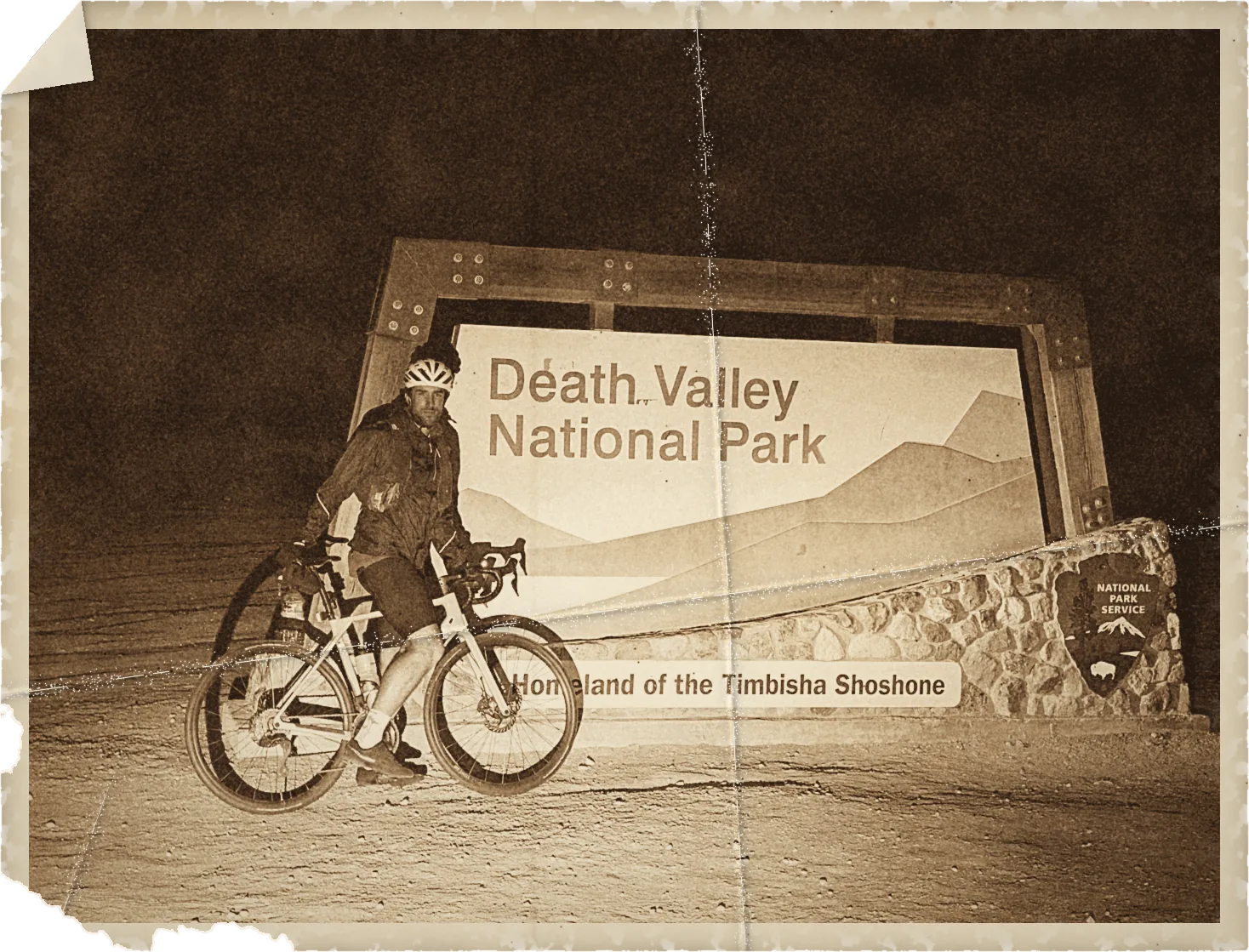
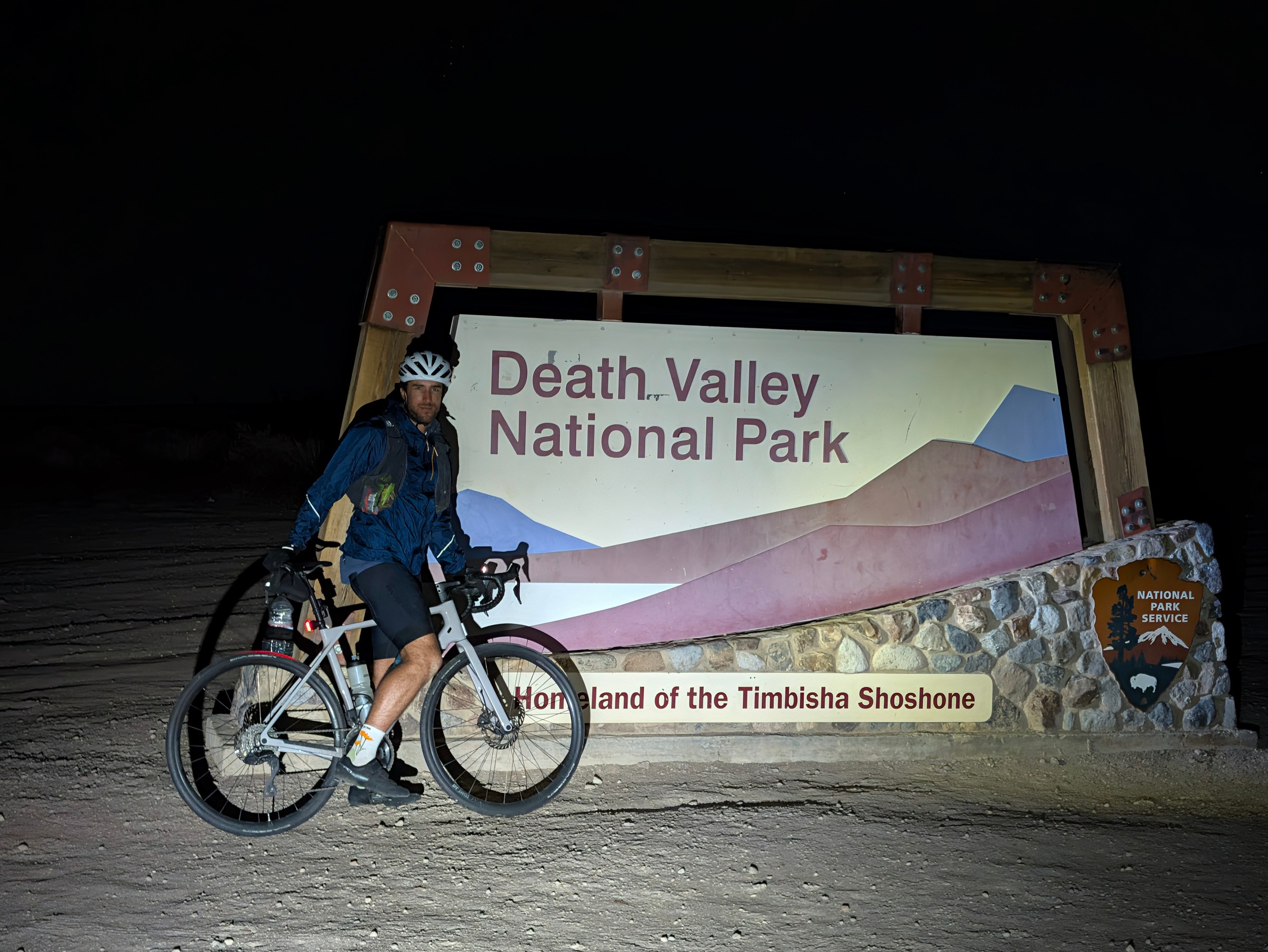
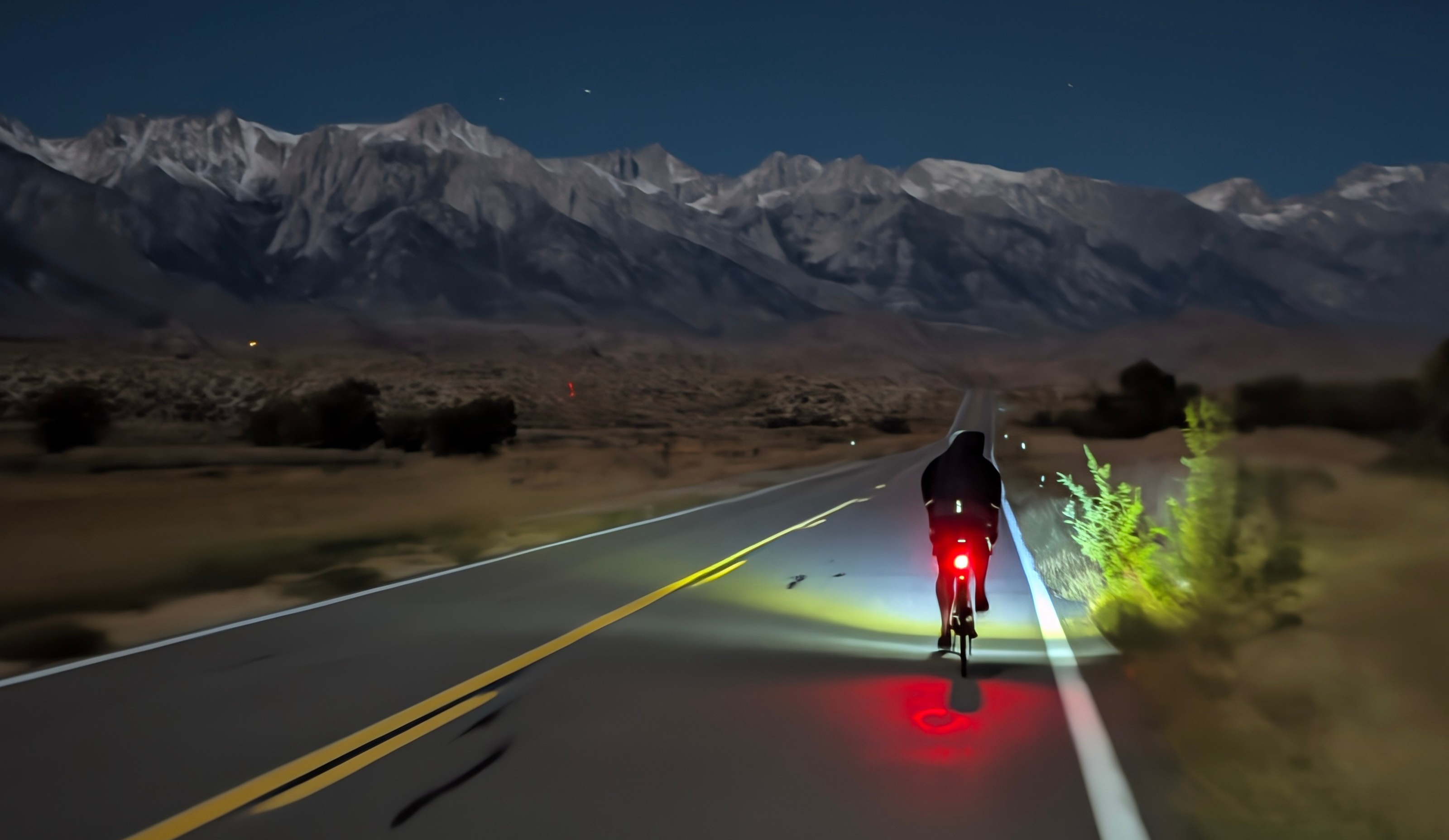
On the long moonlit run towards Lone Pine, Arndt's telephone finally delivered to the group a message he had composed at breakfast:
Telegram · delivered 24 October, 21:20
Arndt — Josh, Mike & I are at breakfast
It had taken fourteen hours to arrive.
Chapter IXA Carl's ——ing Junior
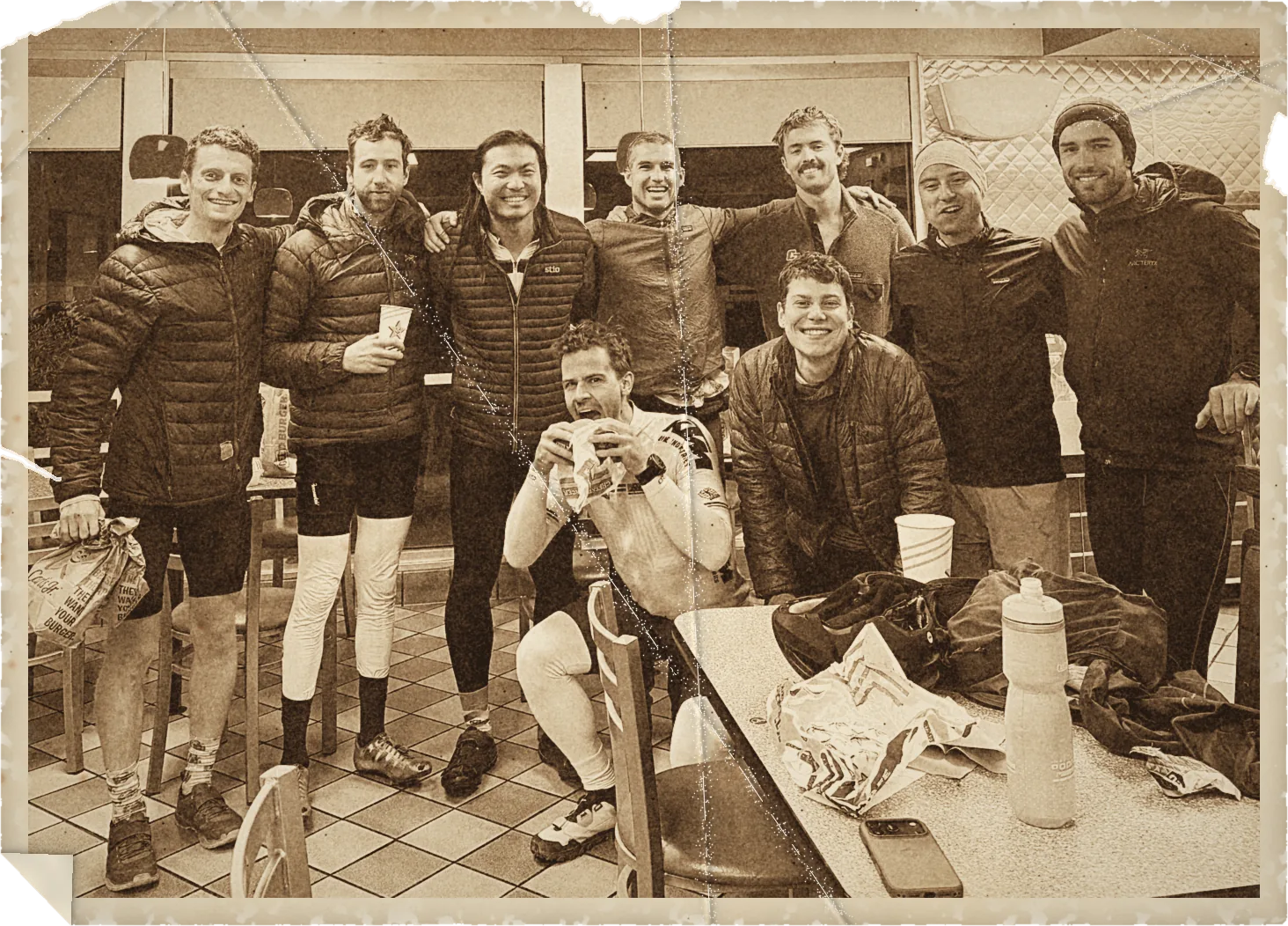
The van had found the McDonald's in Lone Pine drive-through only, and the Carl's Jr. “still open for now”. At 21:50 Holderness reported the fast group's arrival in town, and when Stanford-Moore and Arndt rolled into the Carl's Jr. car park at 22:11, the fast group was still inside, eating. For the first and only time since the start, the entire expedition was gathered in one place. Captain Scott, on reaching the South Pole, wrote: “Great God! this is an awful place.” The expedition, after 200 km (125 freedom miles), two mountain passes and the windiest day of their lives, was reunited in a moment of almost mystical significance in a Carl's ——ing Junior, and felt very differently.
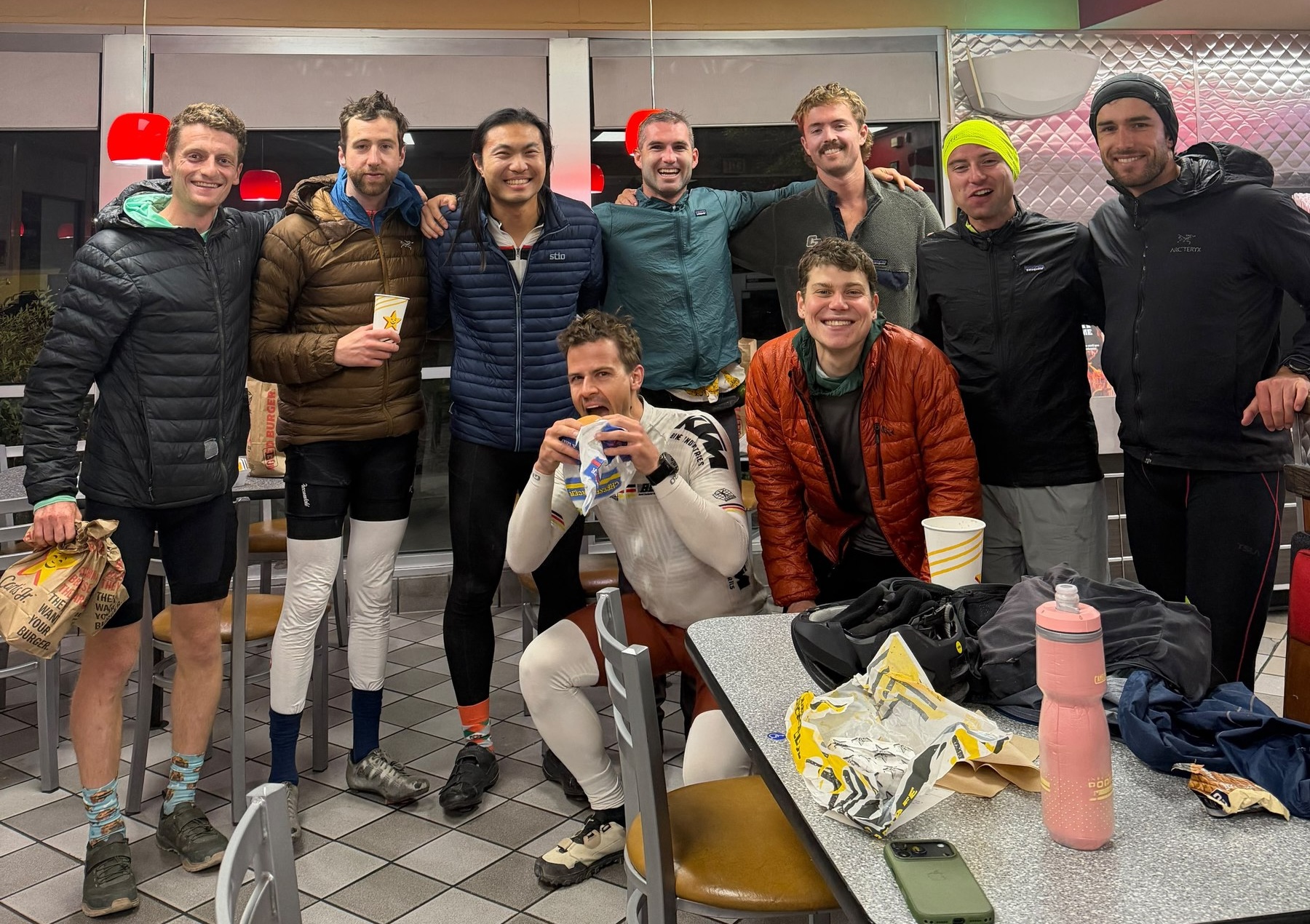
Riggle and Gieschen then set off home to Orange County, taking with them, unknowingly, a set of keys. The six remaining riders climbed the last 1,400 m (4,600 freedom feet) to Whitney Portal, each in silence and at his own pace. Marshall's chronograph died at 22:42, so the rest of his journey is recorded only in his legs; but of the riders whose wristwatches survived to testify, none climbed the Whitney Portal Road faster than Arndt, on the cursed mountain bike, in 2 hours 20 minutes. Having been strung out across 30 km of desert all afternoon, the expedition arrived at the Portal within a quarter of an hour of itself, Arndt at 01:16, fifteen and a half hours after leaving Badwater.
Chapter XThe Mountain
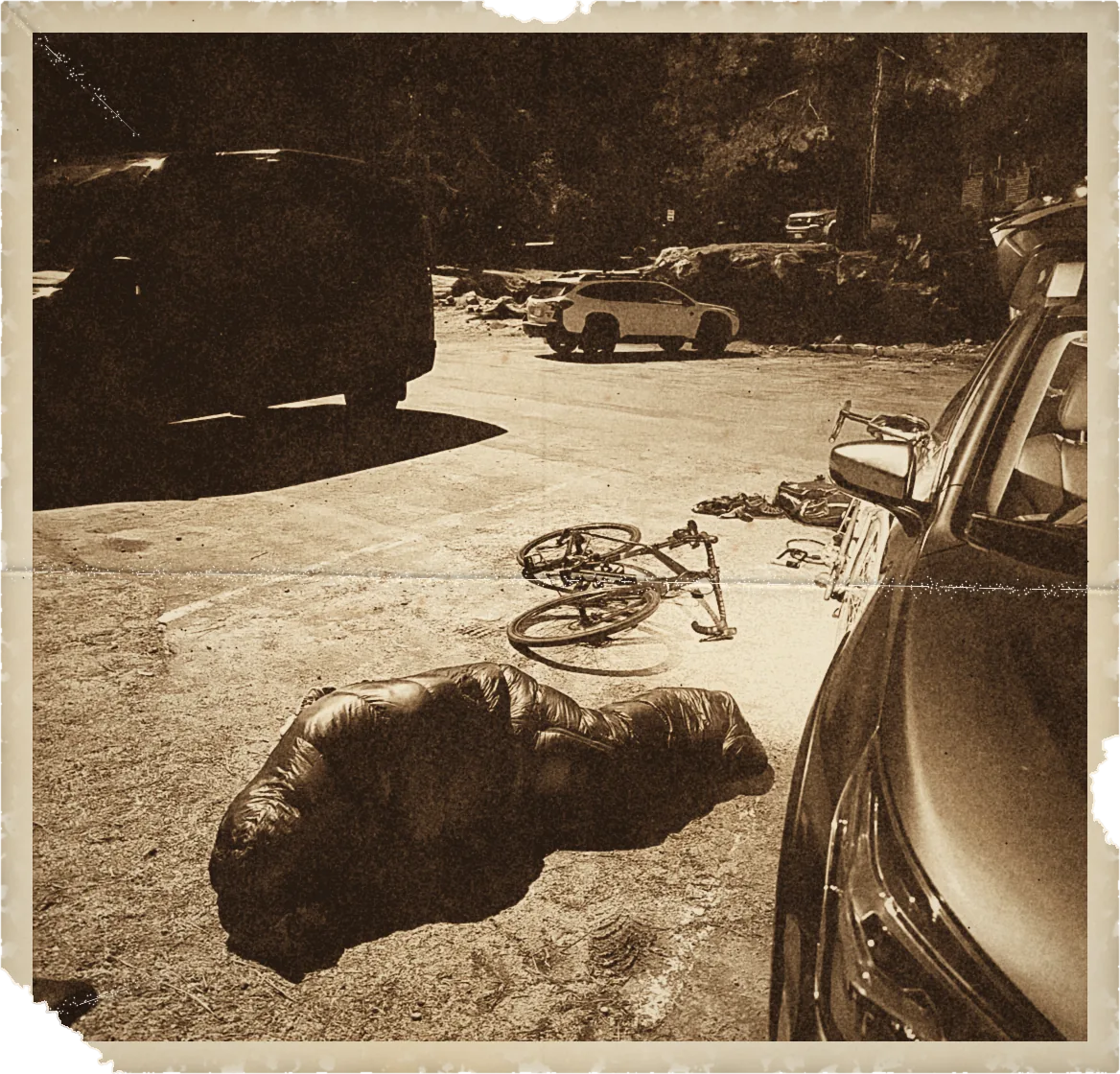
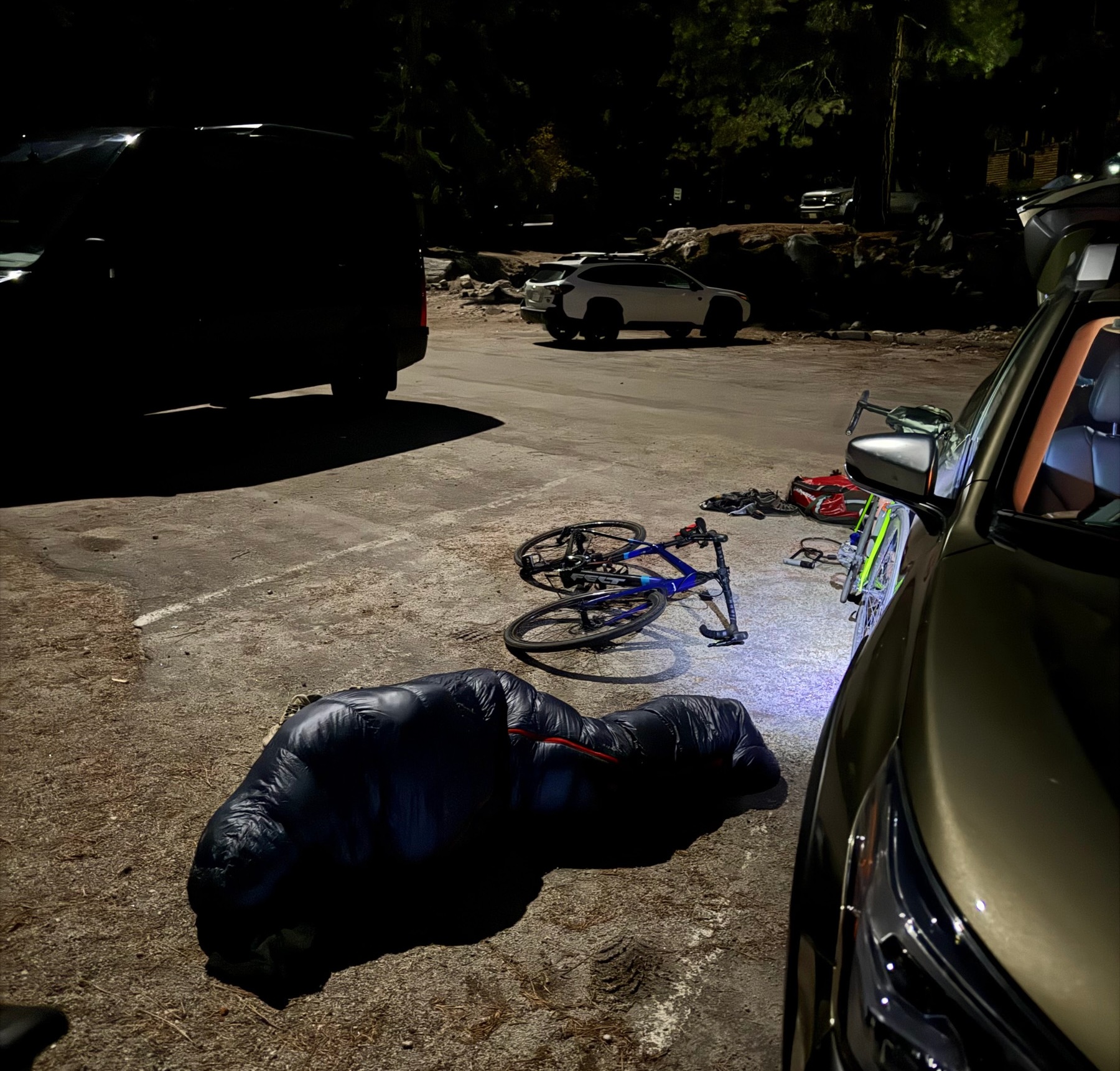
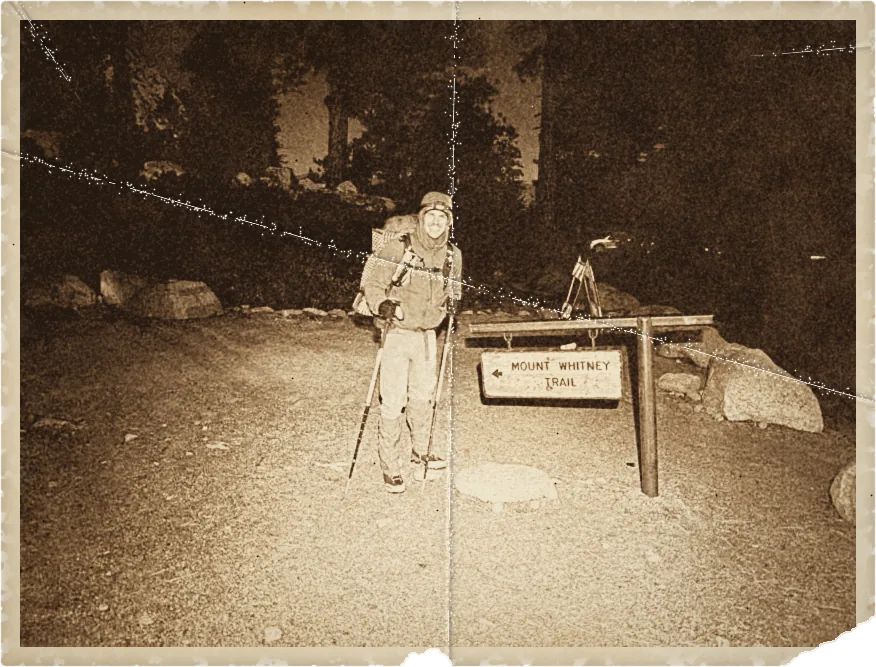
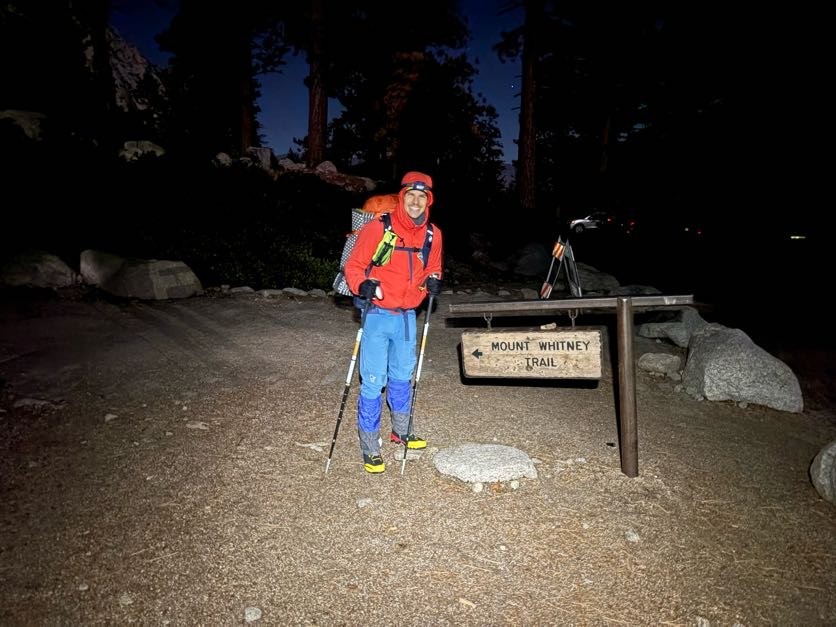
At the Portal, Marshall, Barry, Xia and Sandler went to sleep. Barry curled up in his sleeping bag on the tarmac of the car park the moment he arrived, and Arndt very nearly stood on him. Holderness, Kessler, Stanford-Moore and Arndt ate more and prepared to go straight up. For reasons that remain unclear, Arndt packed coffee, hot chocolate, sandwiches, crackers and a charcuterie plate for the summit (the packing list, in his own hand, says “bring some charcuterie”), and at 02:44 the four set off up the Mount Whitney Trail. Somewhere behind them Barry started up, considered the matter, and decided he did not want to hike. Fourth man down.
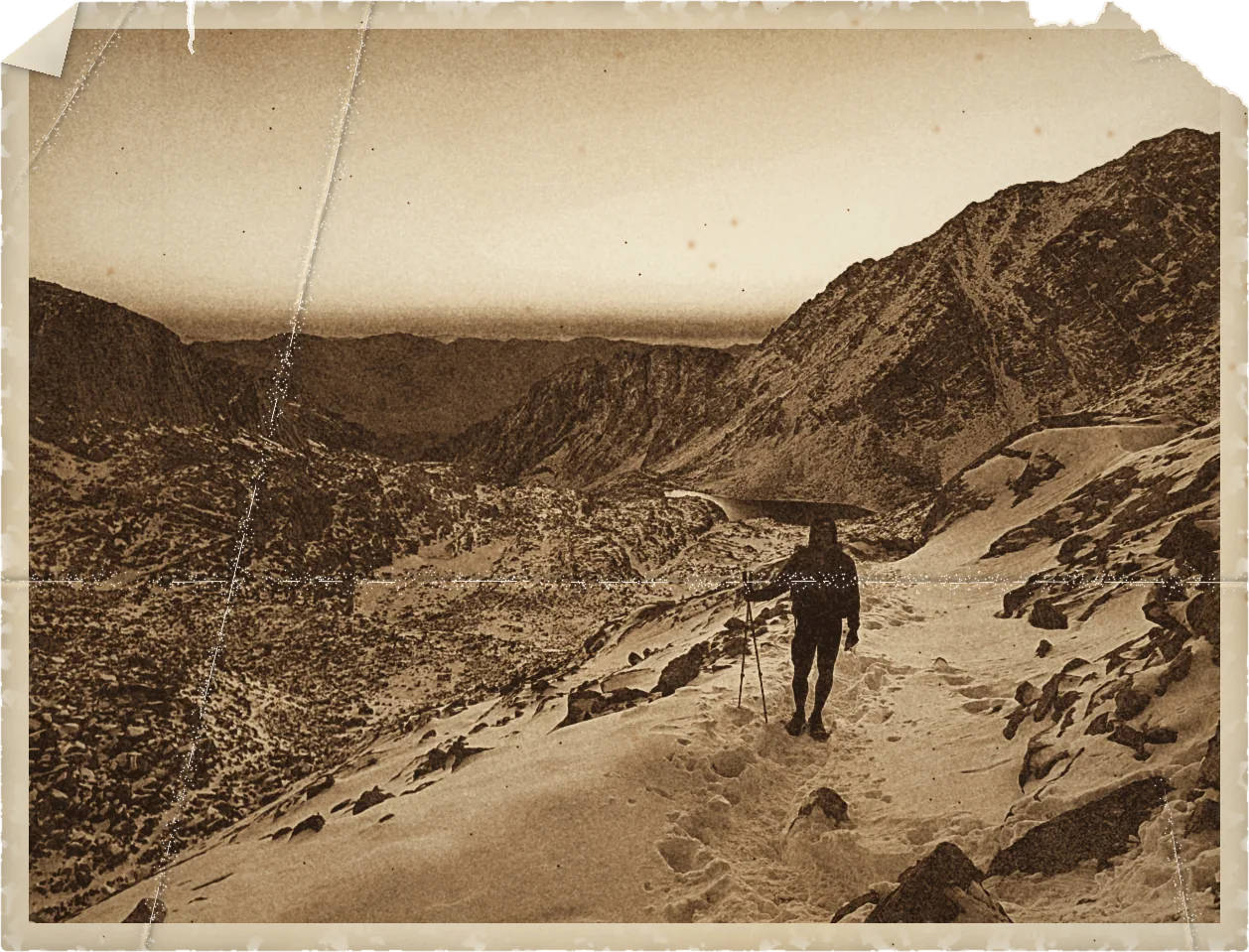
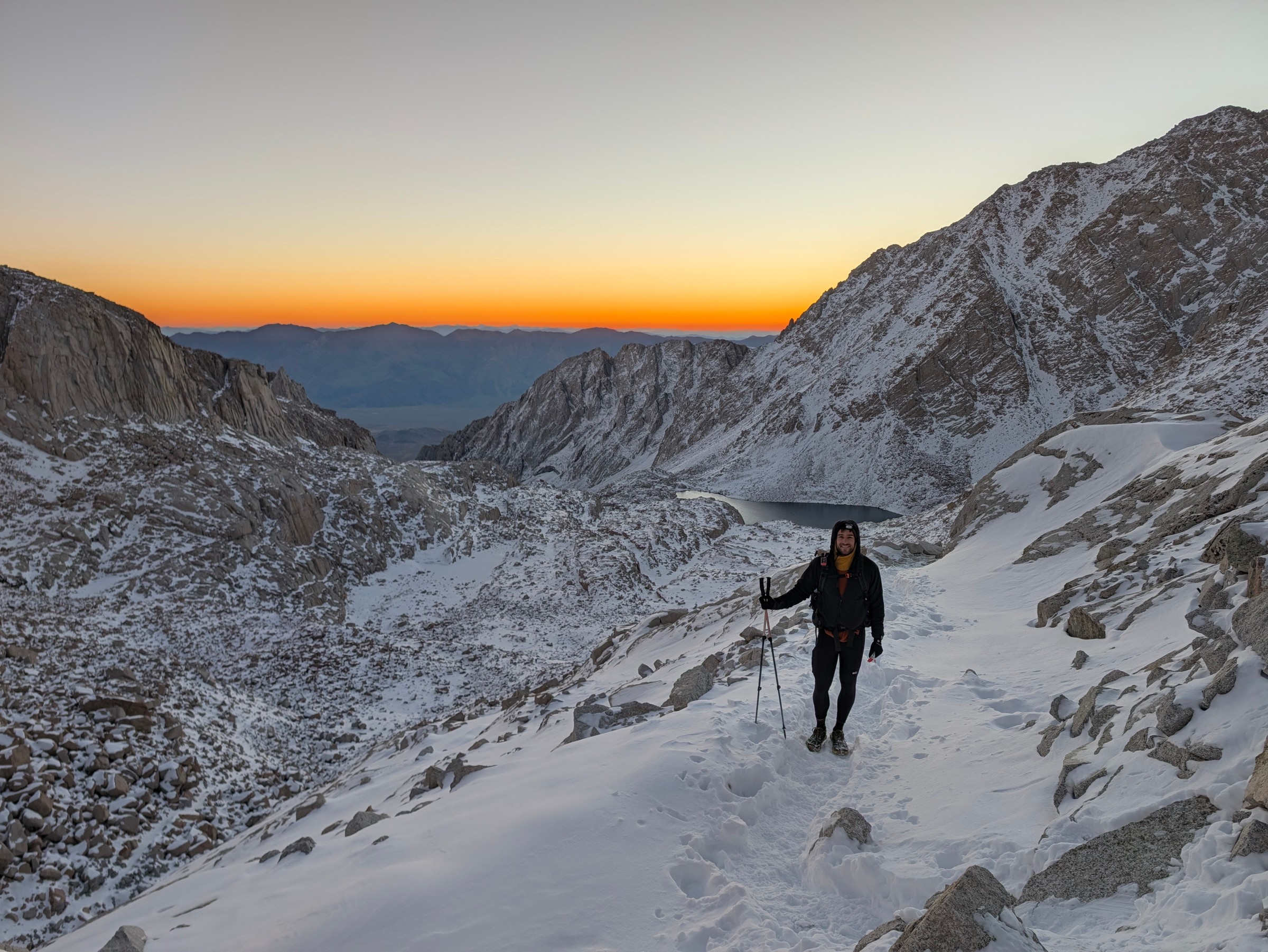
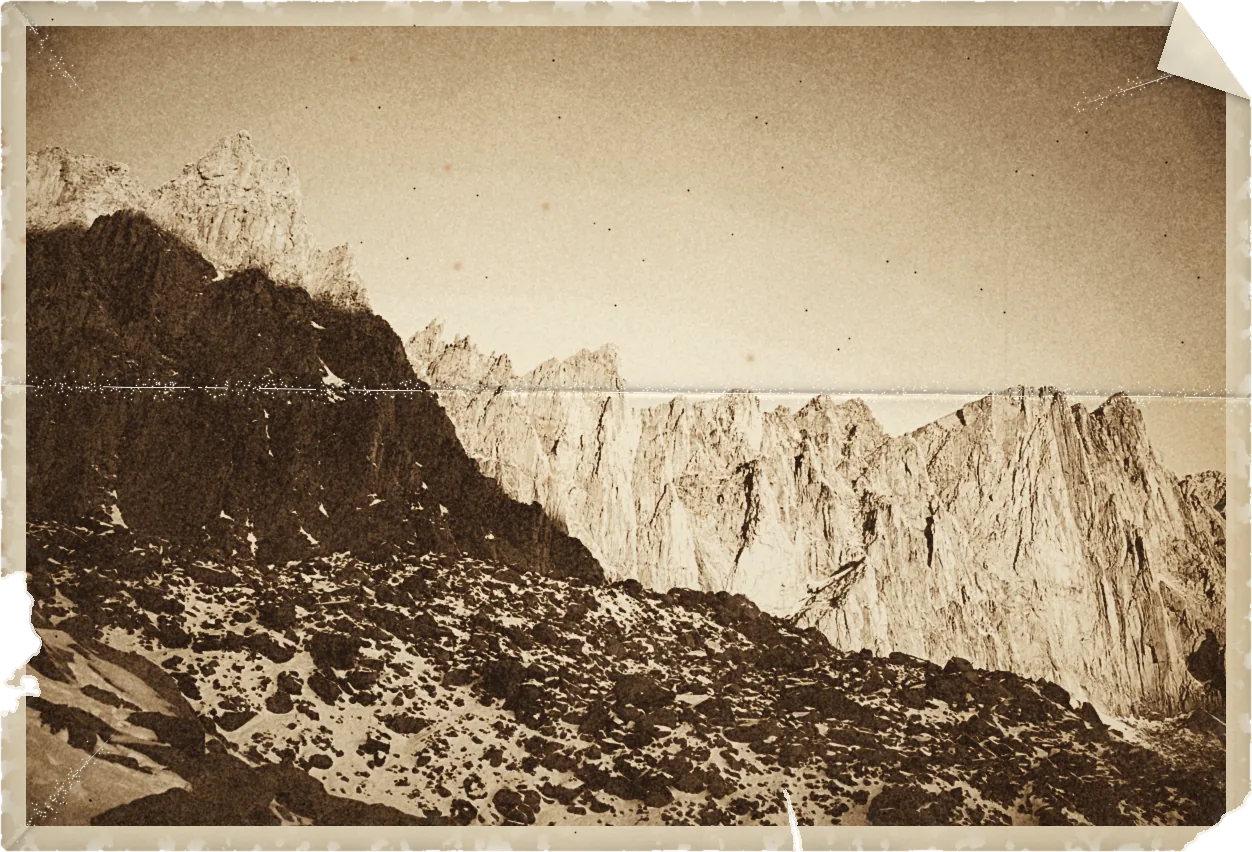
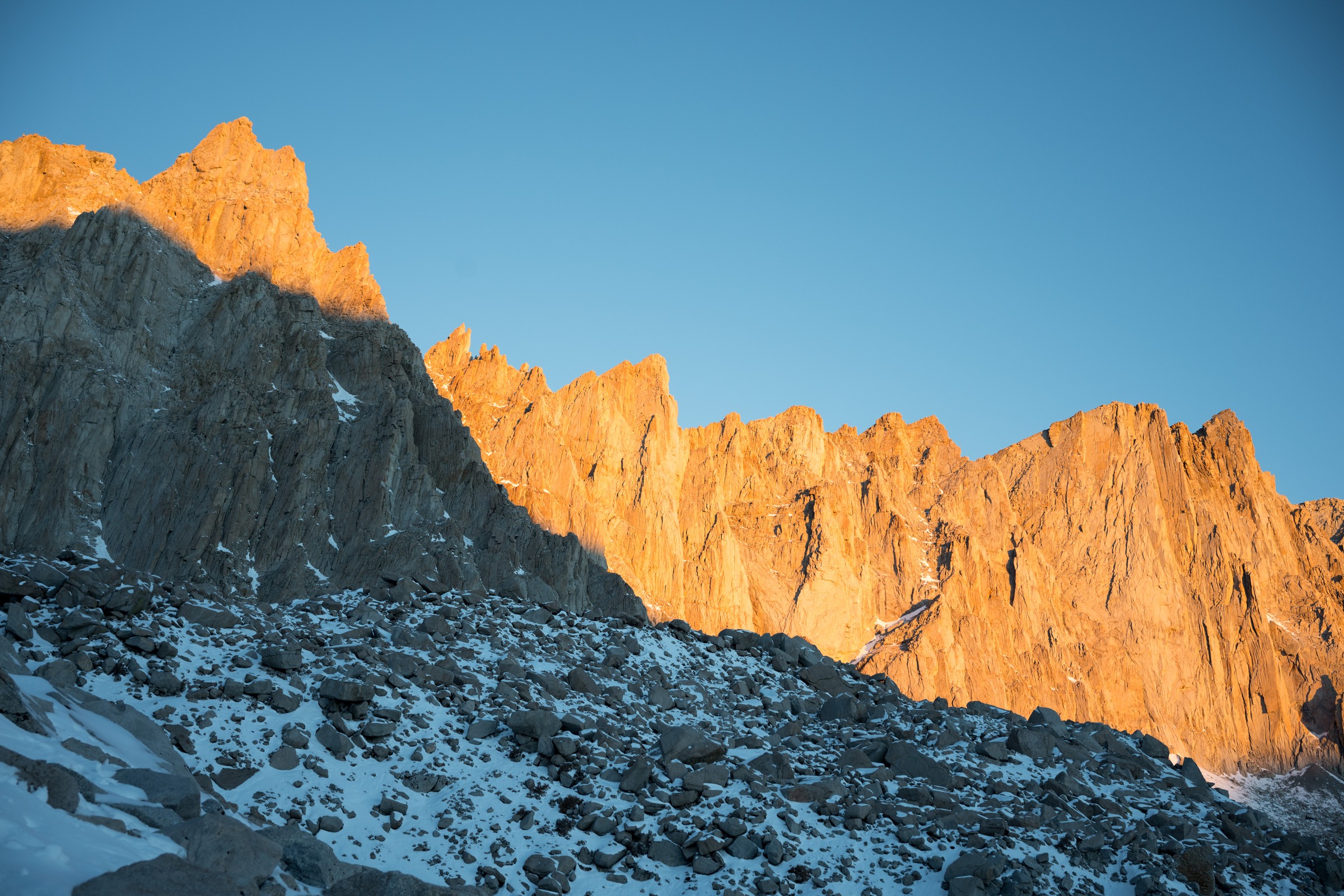
At 06:28 they reached Trail Camp, 3,660 m (12,000 freedom feet), and the foot of the 99 switchbacks. The author considers these absurd. One could simply walk straight up; if switchbacks are needed, twenty or thirty would do. Ninety-nine is a number chosen by somebody who wanted it to sound impressive, and the result is a great deal of walking backwards and forwards across a nearly level slope, getting no closer to the summit in any meaningful sense. The author hates the d——d switchbacks, and would like this recorded. They were also deep in snow. At about seven, halfway up, the sun rose over the Owens Valley and lit Whitney's needles orange, and Holderness, Stanford-Moore and Arndt began to believe they might still reach the summit inside 24 hours. Kessler knew better, and stayed behind them, grinding upwards with absolute consistency.
Chapter XIThe Crest
At Trail Crest, 4,145 m (13,600 freedom feet), the boot track ended. Ahead lay 3 km (two freedom miles) of soft drifts, knee- to thigh-deep, over scree. Such conditions are unpleasant even when fresh. After more than 24 hours awake, 233 km (145 freedom miles) and 6,700 m (22,000 freedom feet) of ascent, they are like being welcomed into a hell that has frozen over. Arndt, who has a tendency to play the hero when in no condition to do so (it was this that had kept him at the front for 70 km with his brake on), broke trail for most of the crest, until the summit came into view and he could not do it any longer.
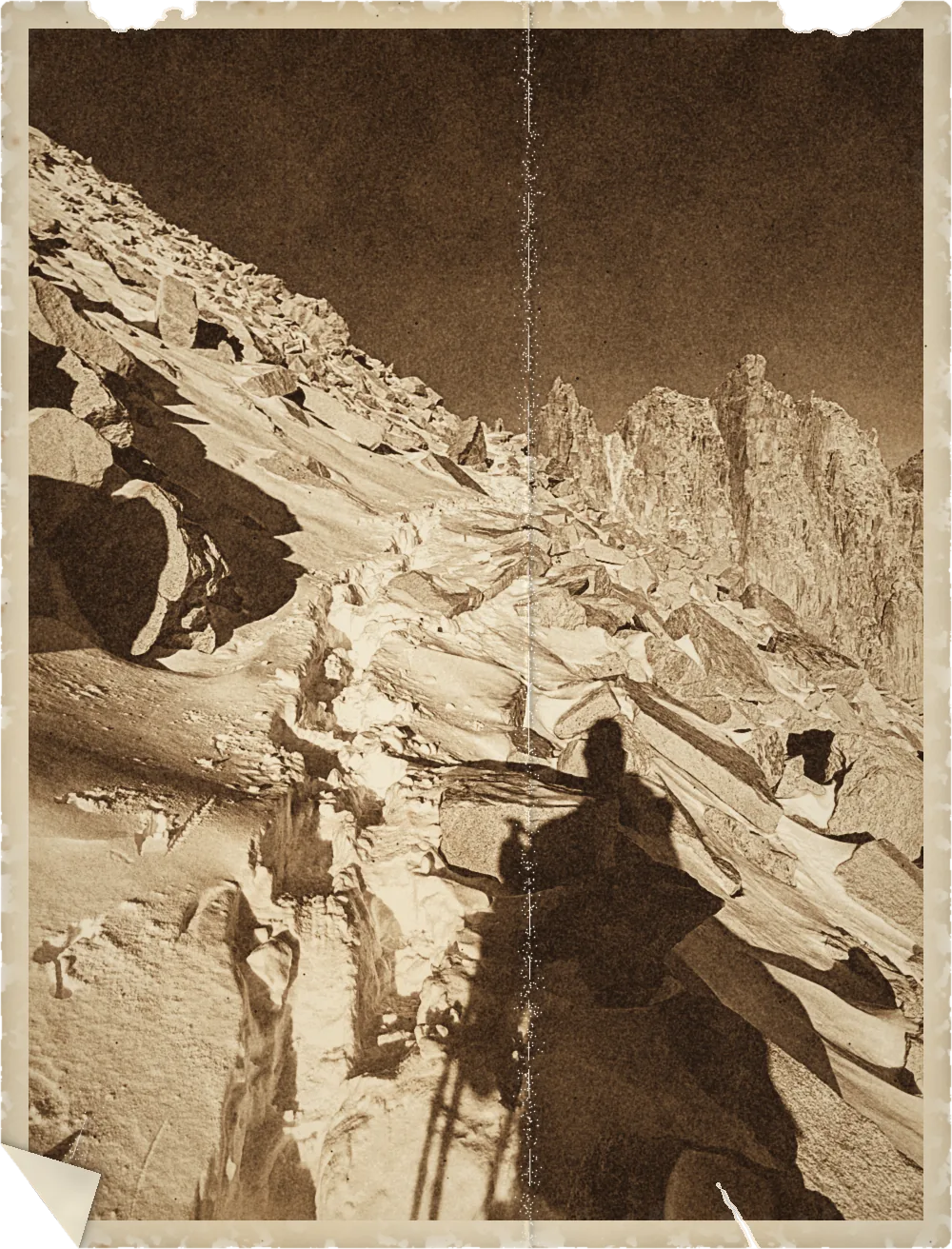
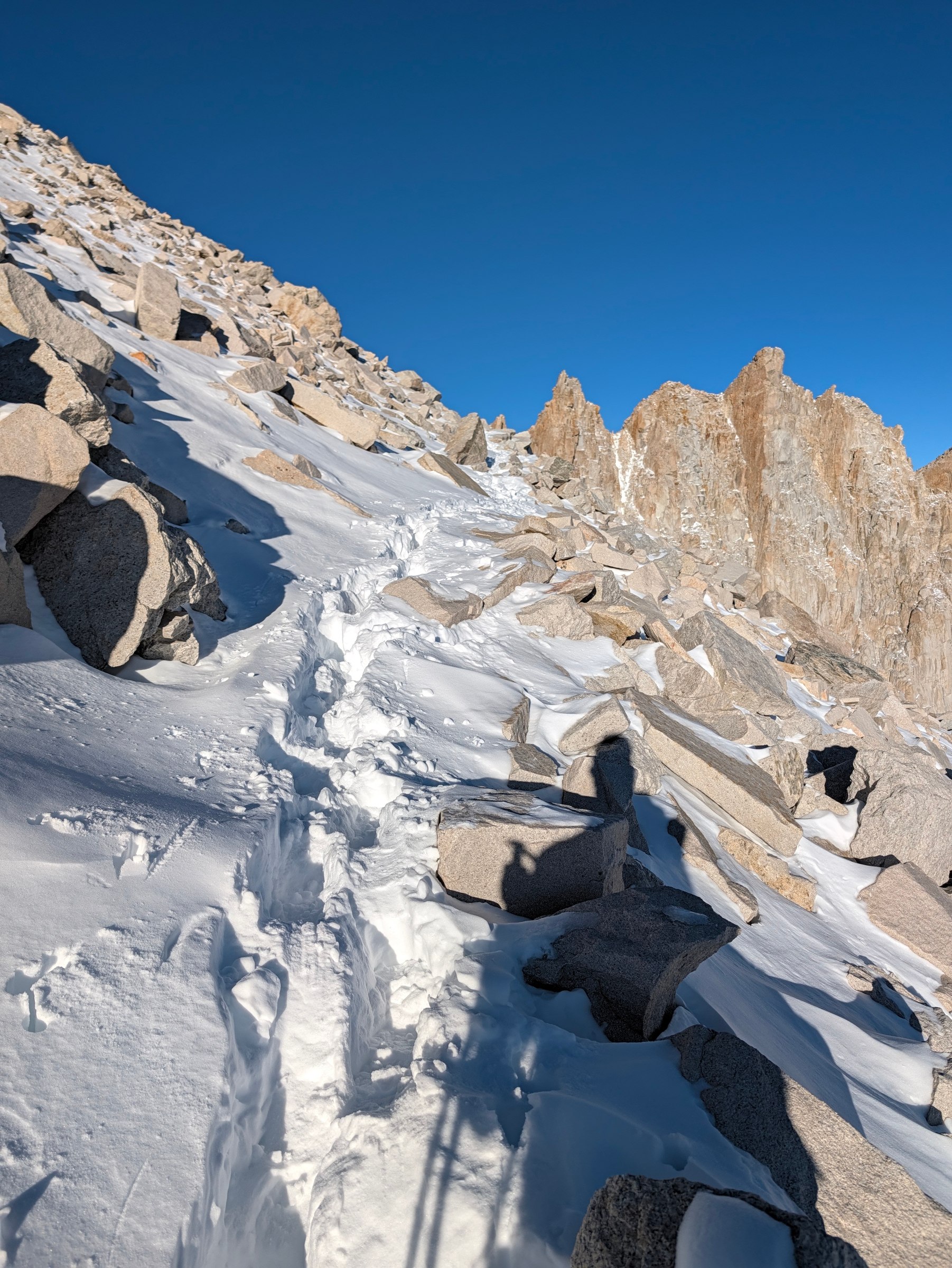
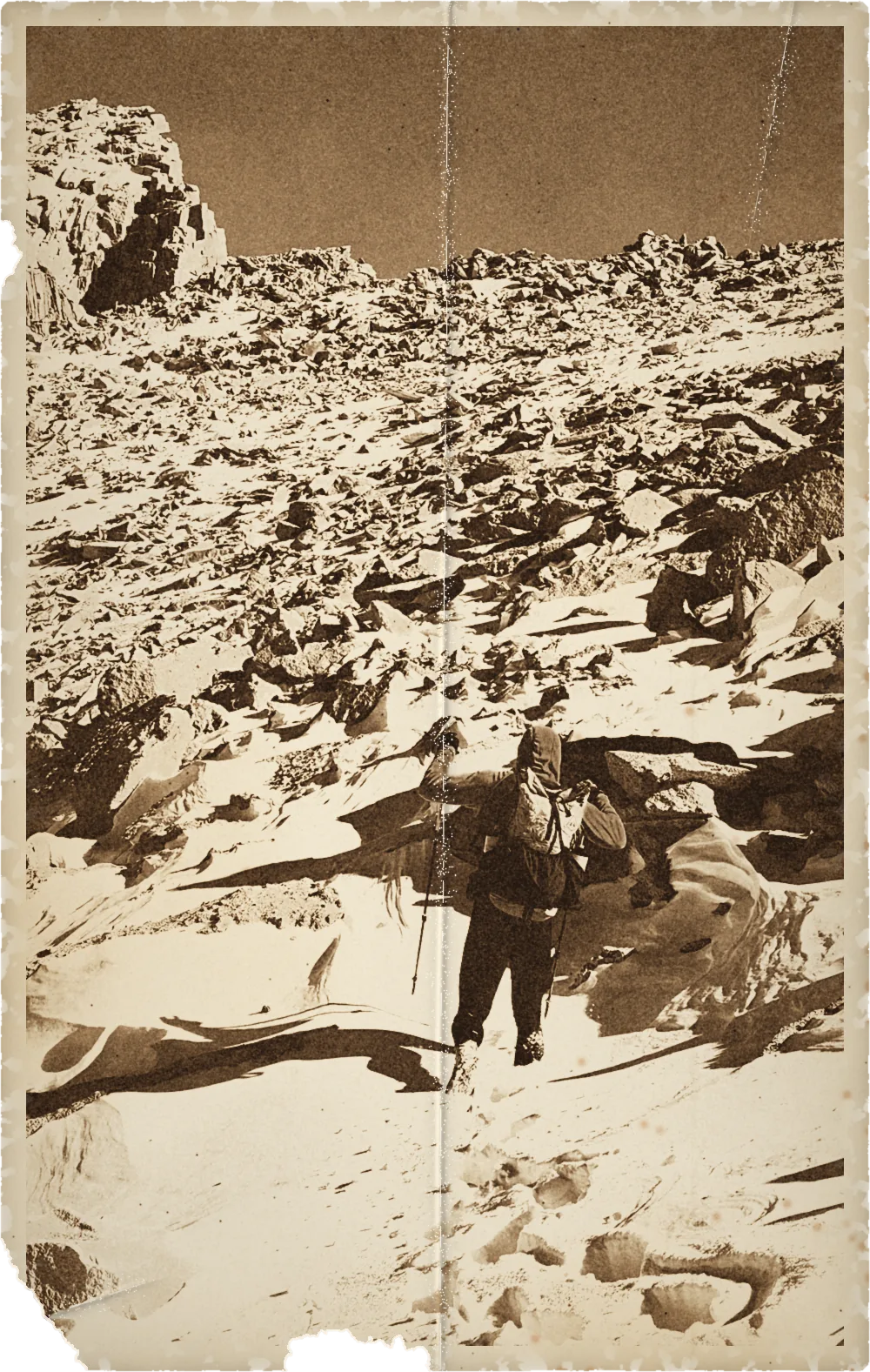
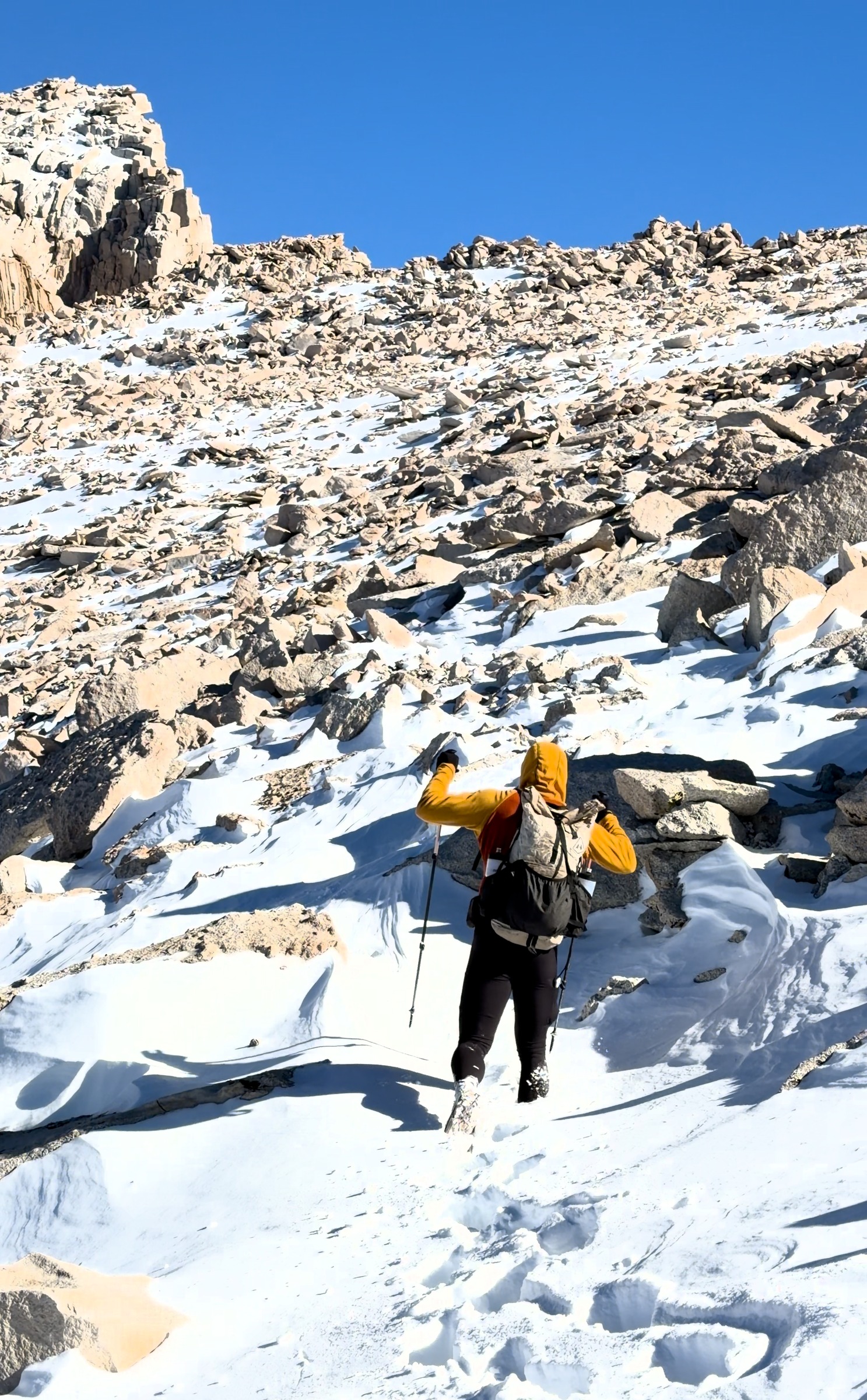
At 09:29 Marshall, who had sensibly slept for two hours at the Portal, passed Kessler. At 09:48:22, exactly 24 hours after Badwater, Holderness was still 1.2 km from the summit, and Arndt 1.6 km (a freedom mile) from it and 190 m (620 freedom feet) below. The 24-hour ambition, to which Arndt had been “committing to the bit” since September, expired quietly in a snowdrift.
From this side, Whitney is a strikingly unimpressive mountain: one last broad hump of loose rock and snow. Holderness found new strength and pushed ahead. Stanford-Moore began to feel very unwell, dizzy, nauseous and off balance; Arndt sat him on a rock and gave him a litre of water, and they rested for 22 minutes, without much improvement. At about eleven o'clock, 463 m (0.29 freedom miles) and 83 m (272 freedom feet) short of the summit, Stanford-Moore made the brave and correct decision to go down. Fifth man down. He had by then passed every other summit on the crest, and in the author's view travelled from Badwater to Mount Whitney in every sense but the pedantic one; one simply should not say “summit” in his presence.
Chapter XIIThe Summit
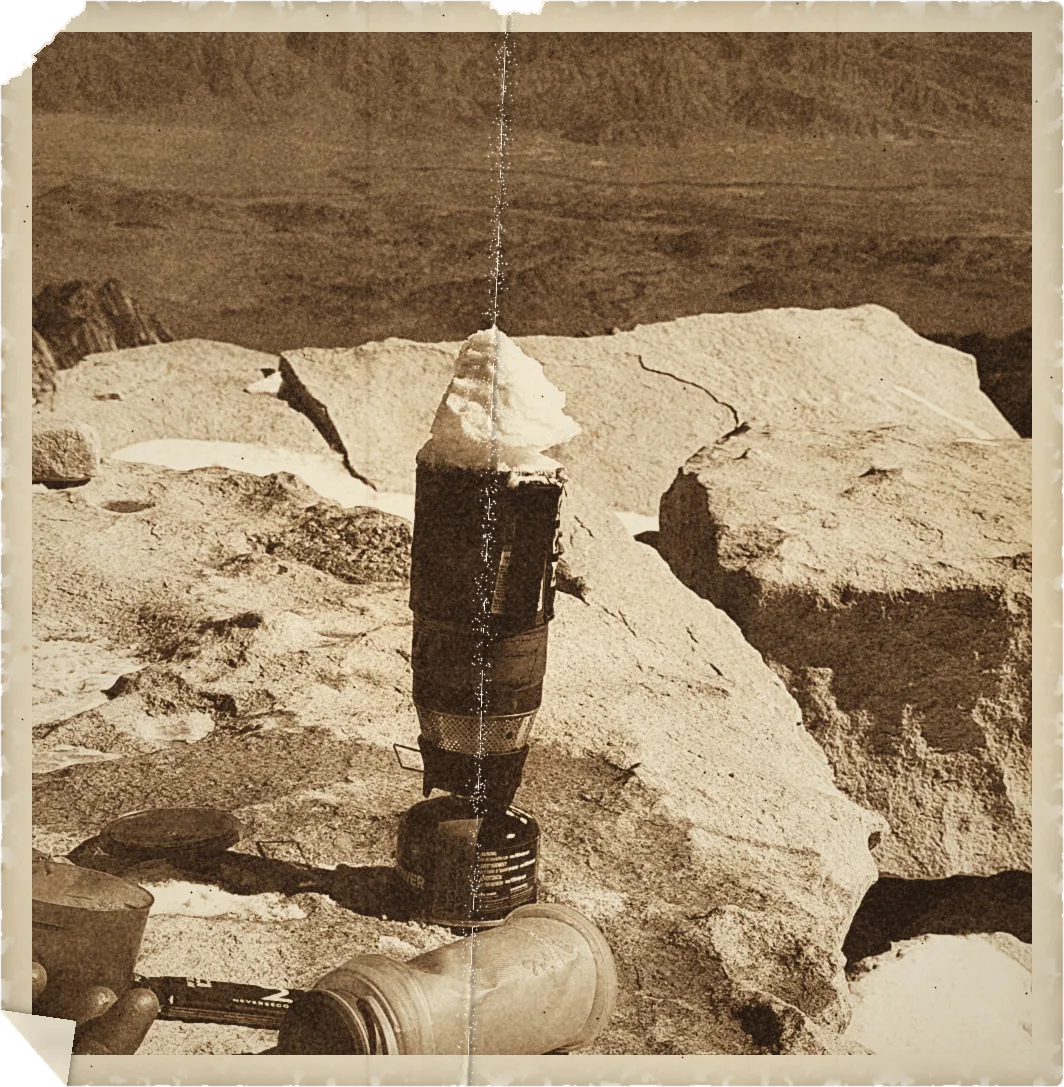
Arndt reached the summit at 11:16:57, 25 hours, 28 minutes and 35 seconds after leaving Badwater. Holderness had been waiting since 10:50; Marshall arrived 30 seconds after Arndt. The author lay down at once, and discovered that his stomach would no longer accept solid food of any kind, so much for the charcuterie, which he presented to another party whose stomachs were in better order. Everybody on the summit was out of water. Here, for once, the author's packing was vindicated: he had brought a small stove. He was incapable of operating it, but Holderness had recovered enough to melt snow for everybody.
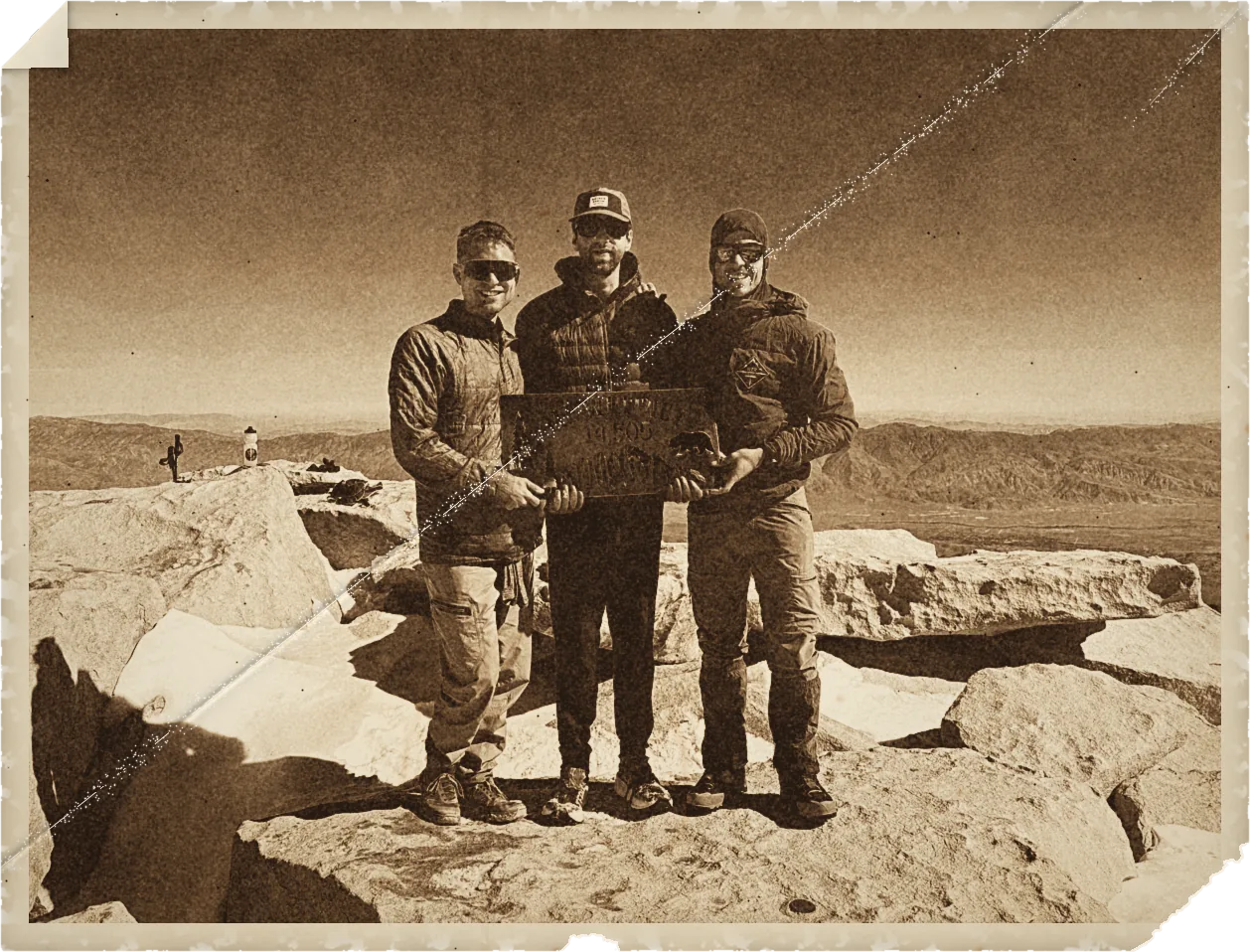
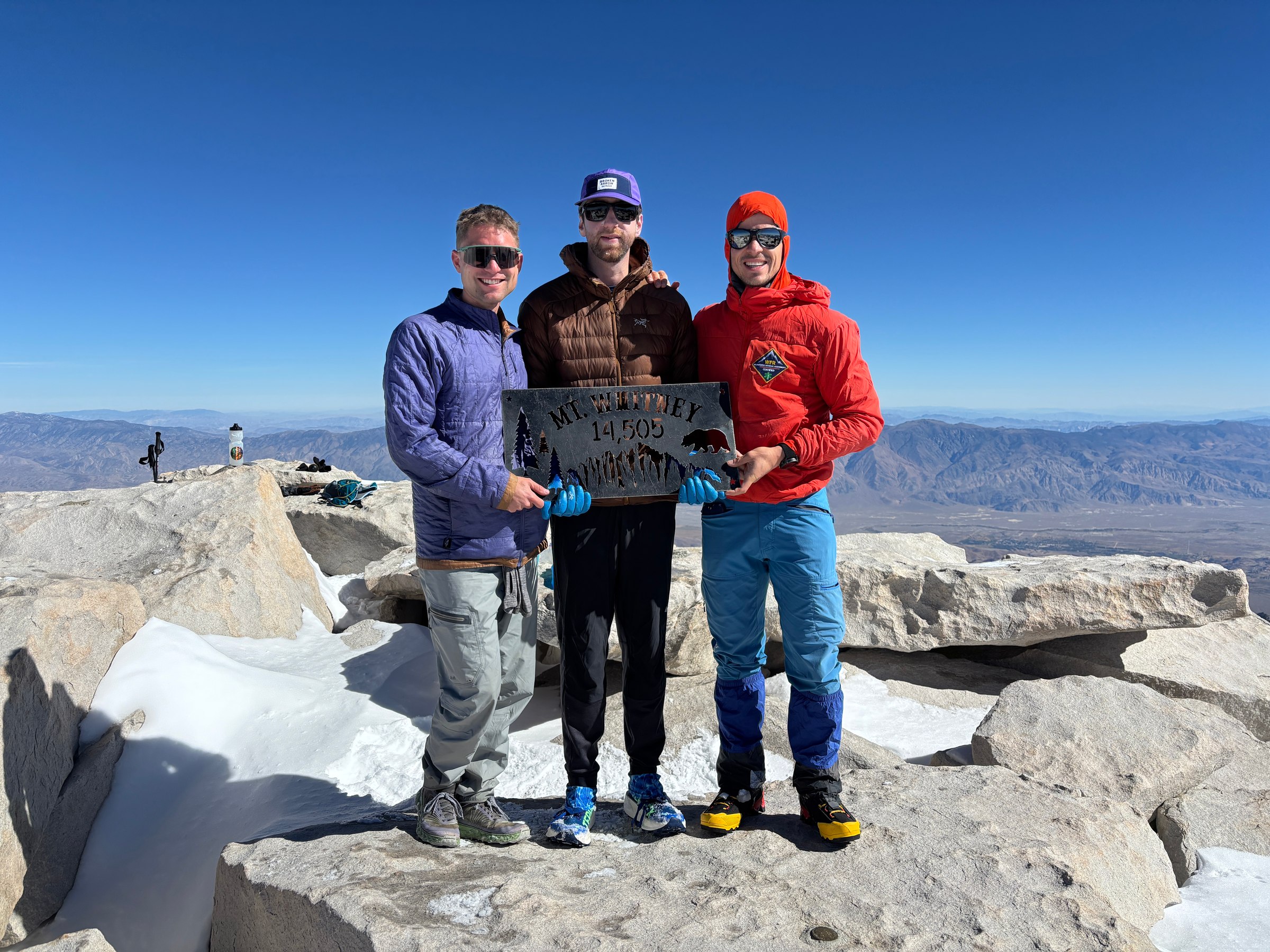
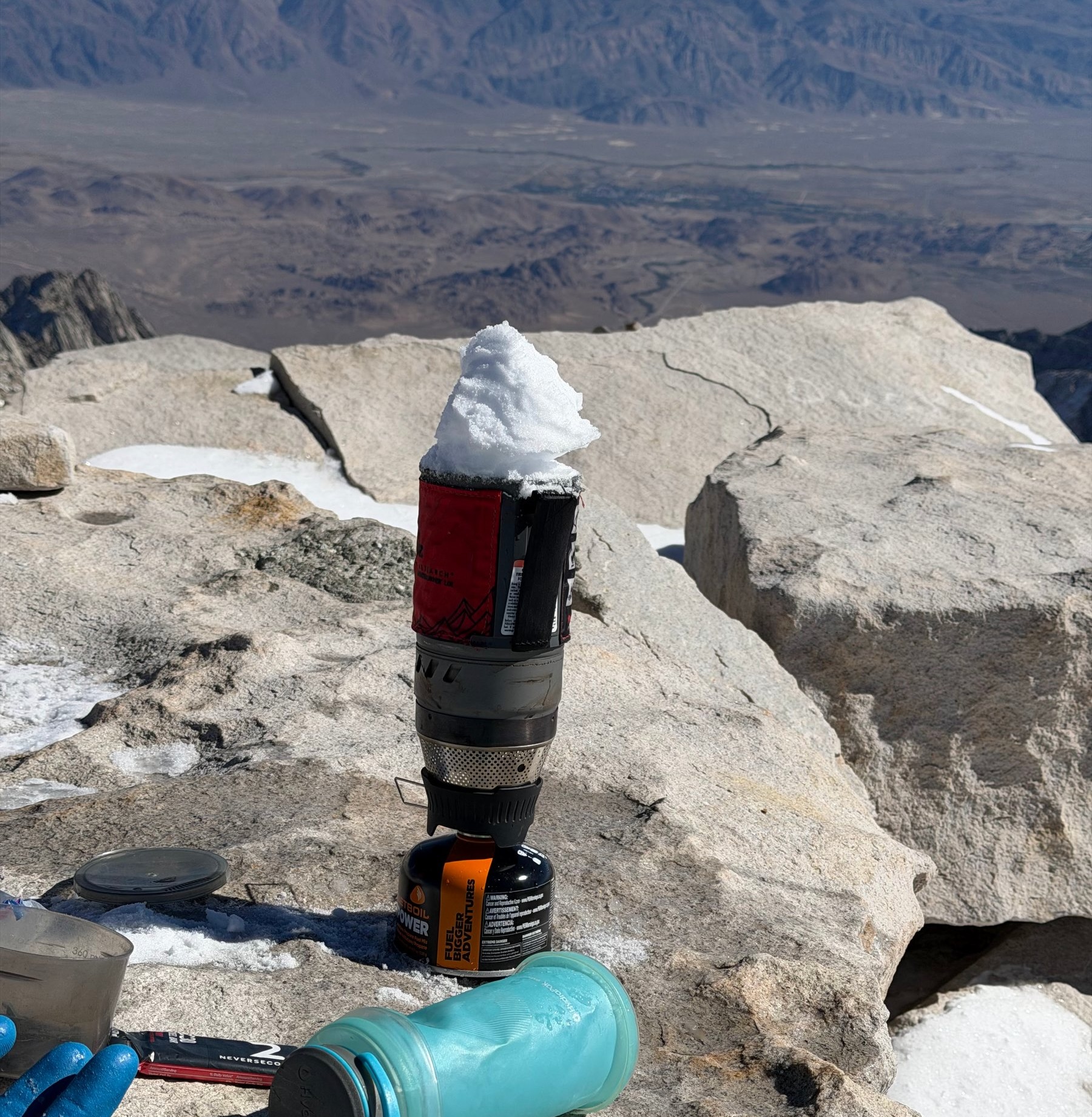
The party spent between fifteen and ninety minutes on top (the author's estimate; his chronograph says about eighty), concluded that everybody else must have given up, and started down, only to meet Kessler coming up. Kessler had announced from the outset that he meant to be the slowest member of the expedition, and he reached the summit at about half past twelve, some 26¾ hours after leaving Badwater, having achieved his ambition in exemplary style.
Chapter XIIIThe Retreat
Every trail is longer in the afternoon. On the crest, between 13:24 and 14:08, Arndt's heart-rate monitor recorded between 52 and 79 beats per minute, dipping below his own resting rate, while he was nominally walking along the crest of the Sierra Nevada at 4,170 m. He prefers to think that he had attained perfect alpine serenity; the likelier explanation is that he was asleep. Somewhere along here the party met Perry, a veteran of this club, who was excited, talkative and bubbly; Arndt tried to match her energy and could not. Then came the switchbacks again, all ninety-nine of them, an eternity and a half of following Marshall's heels and, at about ten to five at Outpost Camp, Stanford-Moore, recovered, together with Kessler, who had come down a great deal faster than he went up. At 18:04 Arndt was back at the Portal, 32 hours and 17 minutes, 255 km (159 freedom miles) and 7,421 m (24,347 freedom feet) of ascent after leaving Badwater. His chronograph rated the training effect 5.0 out of 5: “Overreaching”. The men began to shiver uncontrollably. Xia, rested and recovered, put them in the back of Holderness's heated car, and Arndt passed out.
He awoke in the dark in a car park in Lone Pine. The early retirees had grown over-eager in the matter of logistics and, by a plan the author still cannot comprehend, had moved everything from the Portal down to this car park, leaving Barry to guard it. Barry had been guarding it for hours. (At 17:43 he had asked whether the hikers were back yet, suggested they should not ride down in the dark since their helmets were with him, and noted that his phone was nearly dead.) Marshall had unrolled his sleeping bag on the gravel and climbed into it. The scene resembled a homeless encampment in every respect but one: the number of partially dismantled carbon racing bicycles lying about in it.
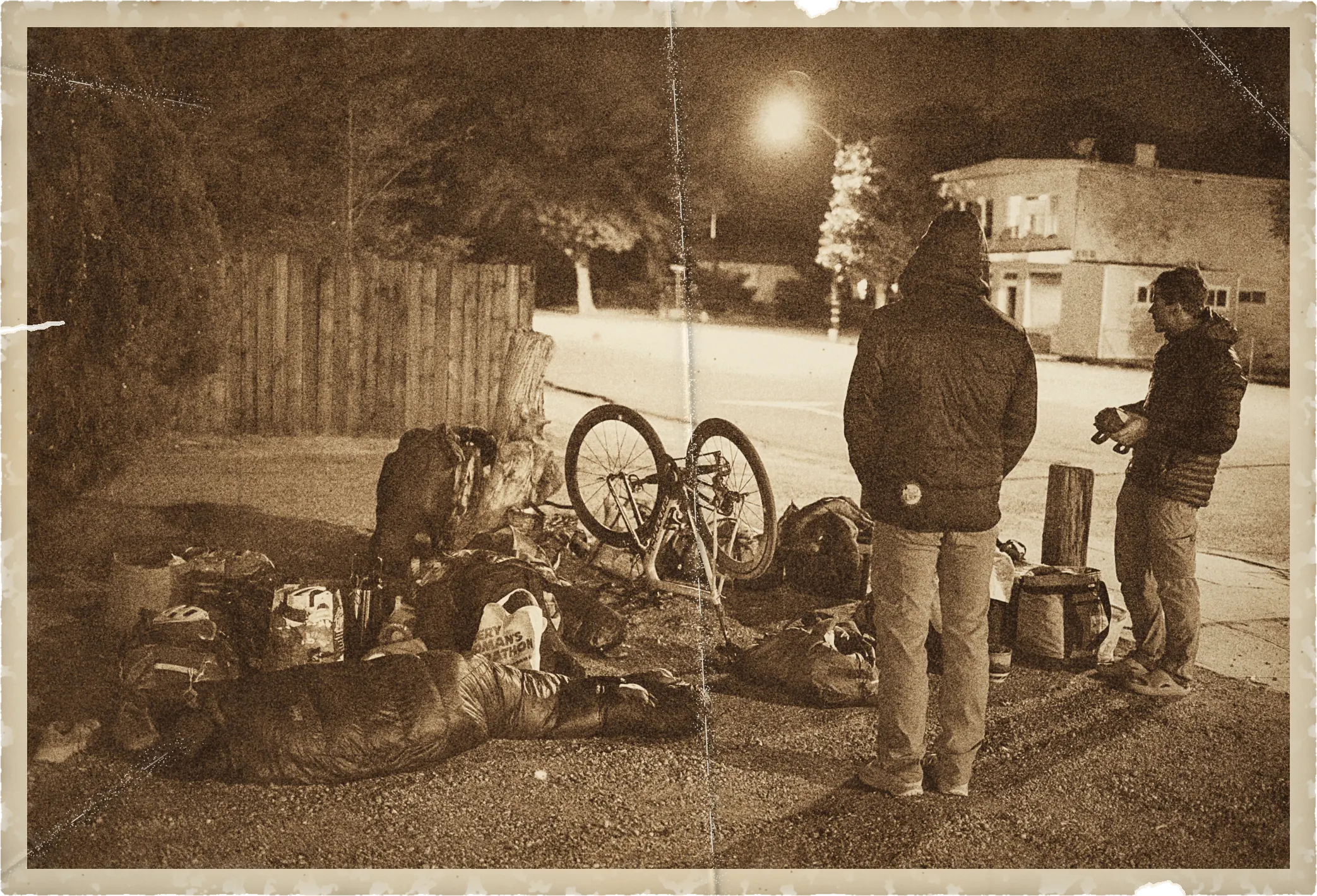
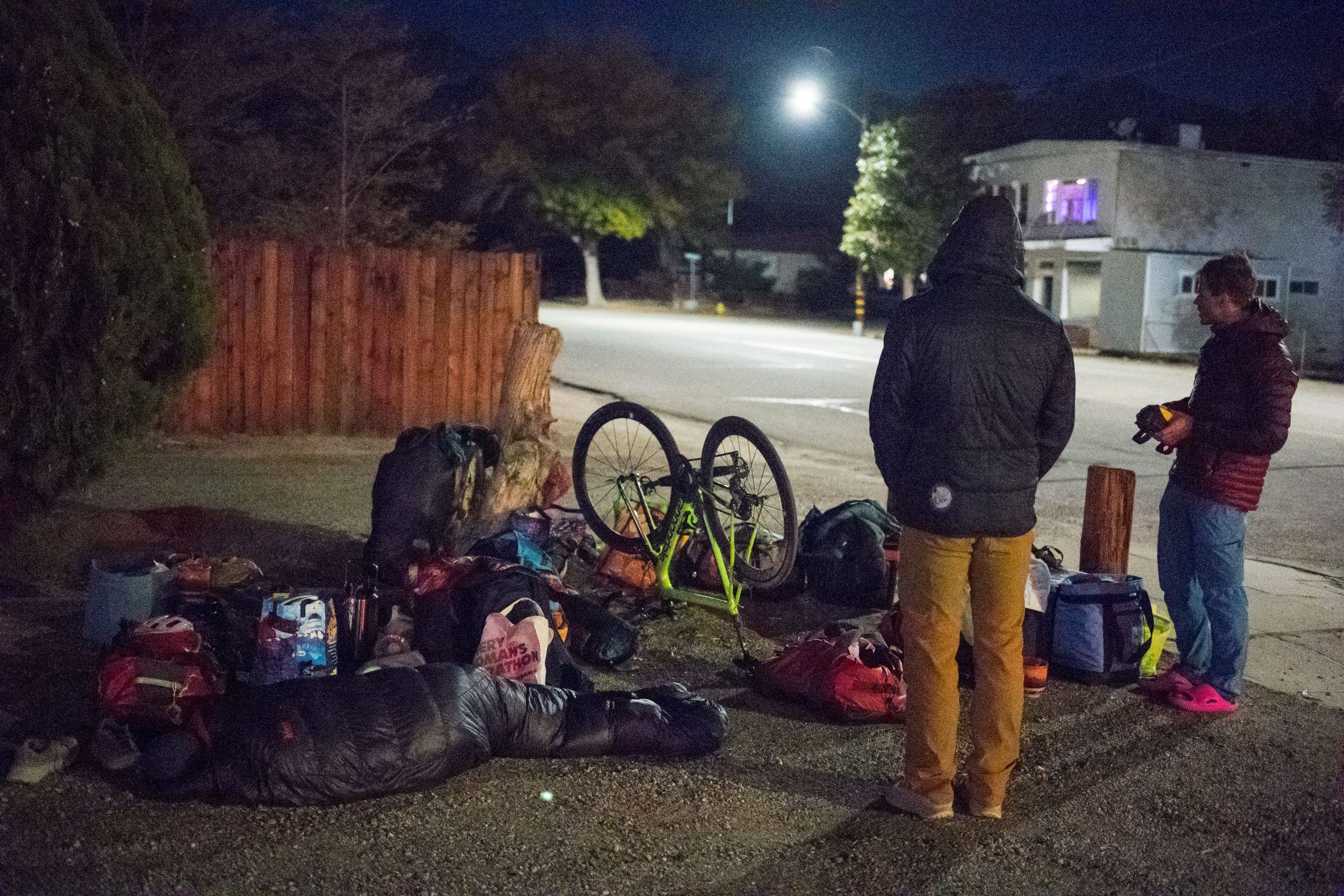
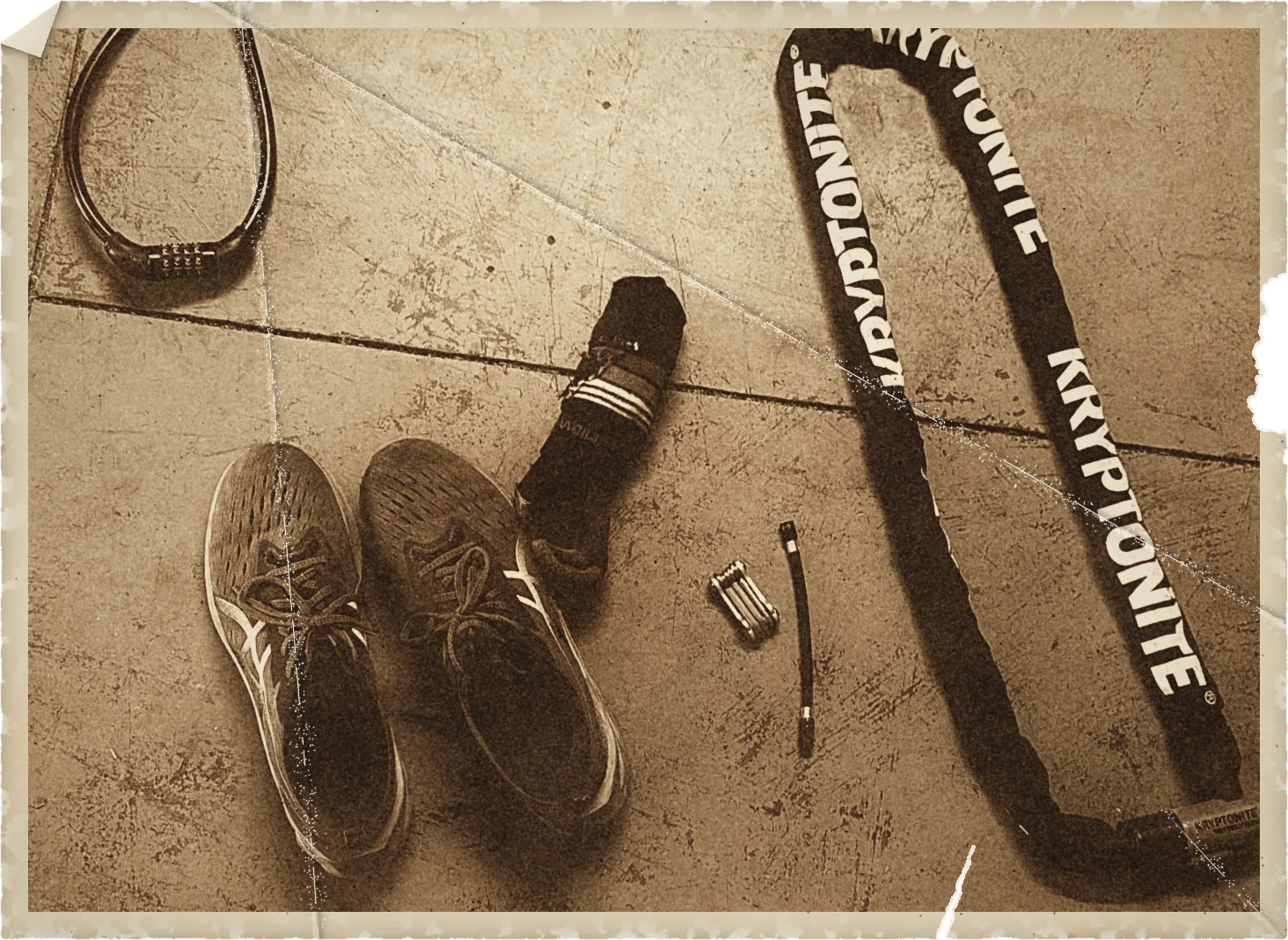
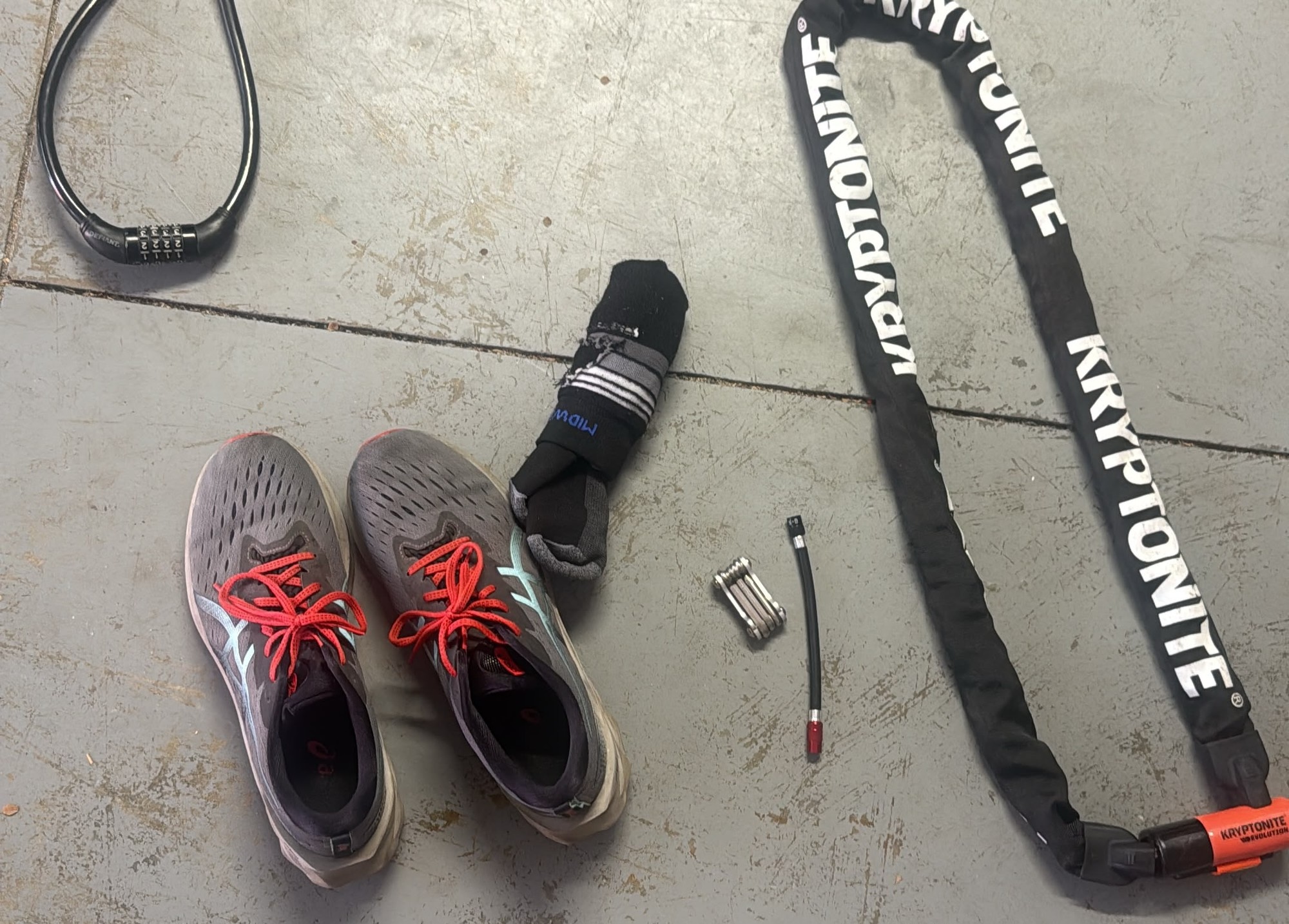
A final difficulty presented itself. The keys that had gone to Orange County with the van included the key to the lock joining Sandler's bicycle to Xia's, in a bush, at Panamint Springs: a San Diego bicycle, firmly locked to a San Francisco bicycle, in the desert, with its key in Orange County. The van's “suspected casualty report”, sent that afternoon, itemised running shoes, a sock, a multi-tool and two entirely different bicycle locks. Xia, the hero the expedition needed, drove the party to Badwater through the night, collecting the conjoined bicycles on the way. Sandler drove home to San Diego with both of them, and the expedition hopes that Xia will one day be reunited with his. Arndt crawled into the back of his Kia Soul at Badwater and went to sleep. Everything else could wait.
EpilogueFindings of the Board of Inquiry
As is customary after an expedition of this kind, a Board of Inquiry was convened. It consisted of the author, at home, with coffee, and it reports the following findings.
- The wind blew at 48 km/h (30 freedom miles per hour) for the first 69 km (43 freedom miles), and was blamed for rather more than it did.
- Arndt's rear brake was engaged over the same 69 km, and accounts for the rest.
- The horses were beaten, twice, a week earlier. The Board notes that the horses were not then required to cycle across Death Valley. On aggregate, the horses won.
- The 99 switchbacks are roughly seventy too many.
- The logistics consumed four hours of correspondence to save two hours of driving, were undone in a single sentence, and ended with two bicycles locked together in a bush.
- Brown's bicycle joined with a flat tyre, flat batteries and the wrong pedals, and left without its rear thru-axle, believed lost somewhere on a Californian highway. Like the Endurance, she did not come home entire. Her owner was in Hawaii.
- The narrator is unreliable. The Board has no further questions.
Of the nine men who left Badwater, four (Holderness, Arndt, Marshall and Kessler) reached the summit of Mount Whitney and a fifth, Stanford-Moore, came within 83 m of it: four and a half, as Arndt put it. Marshall is now five for five. Nobody did it in 24 hours. All agree that it was the hardest thing they have ever done, and several have already begun to call it fun.
“Most weekends you'll probably forget,” as Holderness put it. “You won't forget this one.” This is true, but only for now. Sandler has signed off his own account of the day with “Gotta run it back”, Xia has promised that he will be back, and within months, the author predicts, the survivors will be persuading other people that it would be fun to do some time. The best alpinists, after all, are the ones with the worst long-term memory.
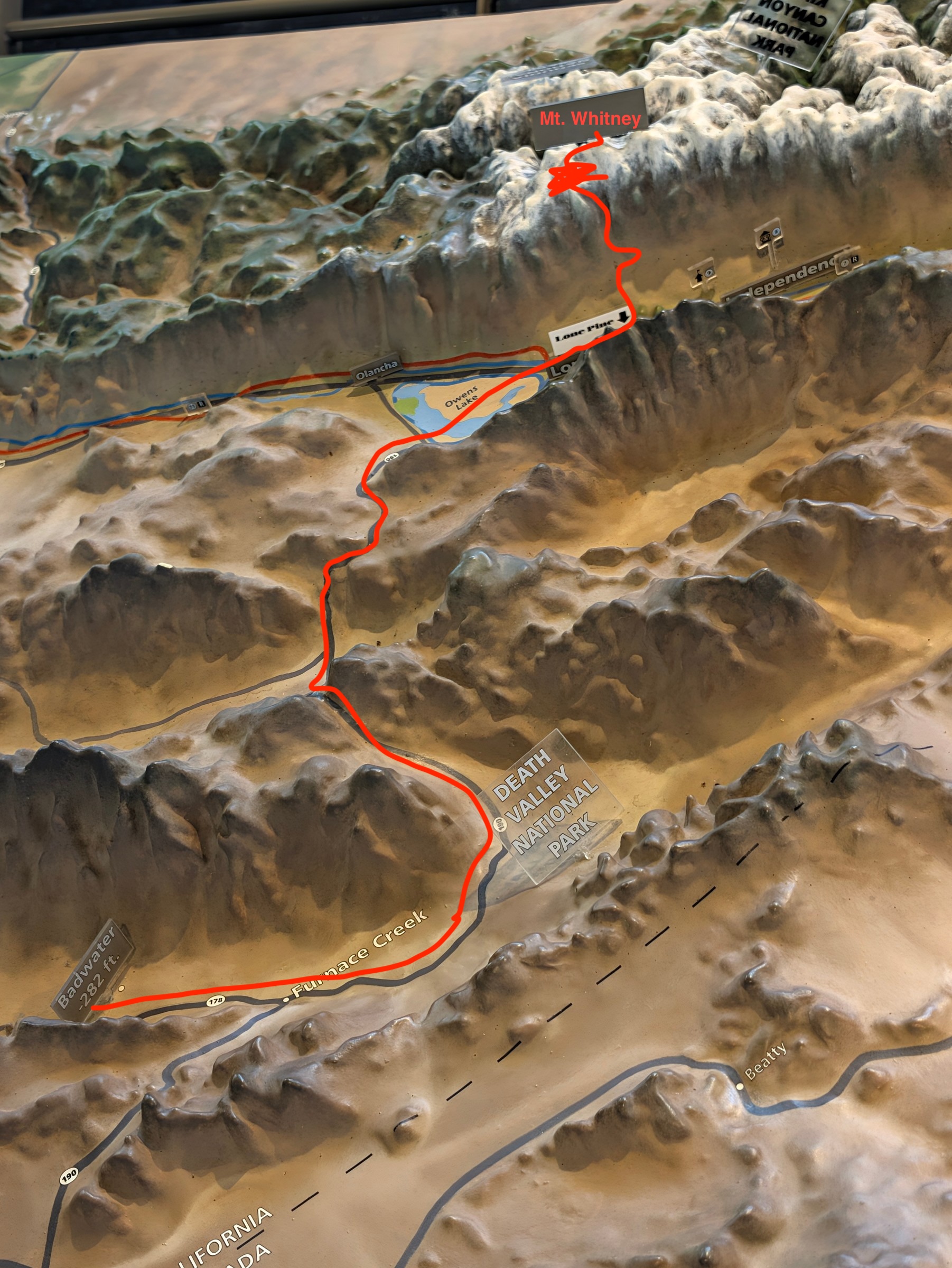
AppendixThe Route, with Casualties
- 1Badwater Basin, −86 m (−282 ft). Start, Saturday 09:48.
- 2Stovepipe Wells, km 69 (mile 43). The brake is discovered.
- 3Towne Pass water cache, km 90 (mile 56), 1,075 m (3,527 ft). Sandler retires, 16:06.
- 4Panamint Springs, km 119 (mile 74), 583 m (1,913 ft). Xia retires.
- 5Below Father Crowley Point, km 132 (mile 82), 1,251 m (4,104 ft). Gieschen retires, about 19:50.
- 6Lone Pine, km 200 (mile 125), 1,136 m (3,727 ft). The Carl's Jr. reunion, 22:11.
- 7Whitney Portal, km 220 (mile 137), 2,548 m (8,360 ft). End of the ride, 01:16. Barry retires.
- 883 m (272 ft) below the summit. Stanford-Moore turns back, about 11:00.
- 9Summit of Mount Whitney, 4,421 m (14,505 ft). Holderness 10:50; Arndt and Marshall 11:17; Kessler about 12:30.
- 10Whitney Portal, km 255 (mile 159). Arndt finishes at 18:05, 32 h 17 min after leaving Badwater.